· 7 min read
You Know Your Customer. Your Pricing Likely Doesn't.
Knowing the customer might be the easy part, what to do with it?
 Max RymenCo-Founder · Pricing
Post 6 · C · Carbon
TLDR: Every B2B company will tell you it knows its customers. However, ask which combination of characteristics, in those customers, actually predicts what each one will pay you. I doubt you will get a good answer. Pricing is one of the most direct uses of customer knowledge there is. The segments you carry around today were built by marketing for messaging, by sales for pipeline routing, ... They were not built to price.
Jeroen & I spent two days at IMEC ITF last week. I am from Antwerp, and for those 2 lovely days, we were the capital of DeepTech. We also heard a lot of recognizable challenges from innovators:
“We’re three times smaller than the next thing on the market. What does that mean from a pricing perspective?”
“By IP standards, the prices charged are extreme. What’s the right business model?”
“What’s the real value? What’s the ROI? We have these massive challenges on the commercial side.”
“People want a problem solved. Not just compute power. The race is for operations per second per euro, not for qubits.”
Schrödinger’s price?
Each is a pricing question and a segmentation question at once. Same chip in three or four different buyer worlds, with very different willingness to pay. The same imaging sensor can work in a security camera, an automotive cabin module, an AR headset. The same liquid cooling rig goes to a hyperscaler datacentre, a telco edge box, an industrial computing room. The same photonic processor lands at a sovereign research lab, a cloud-services buyer, an industrial integrator. The buyers don’t get the same value out of them. Most pricing models still pretend otherwise.
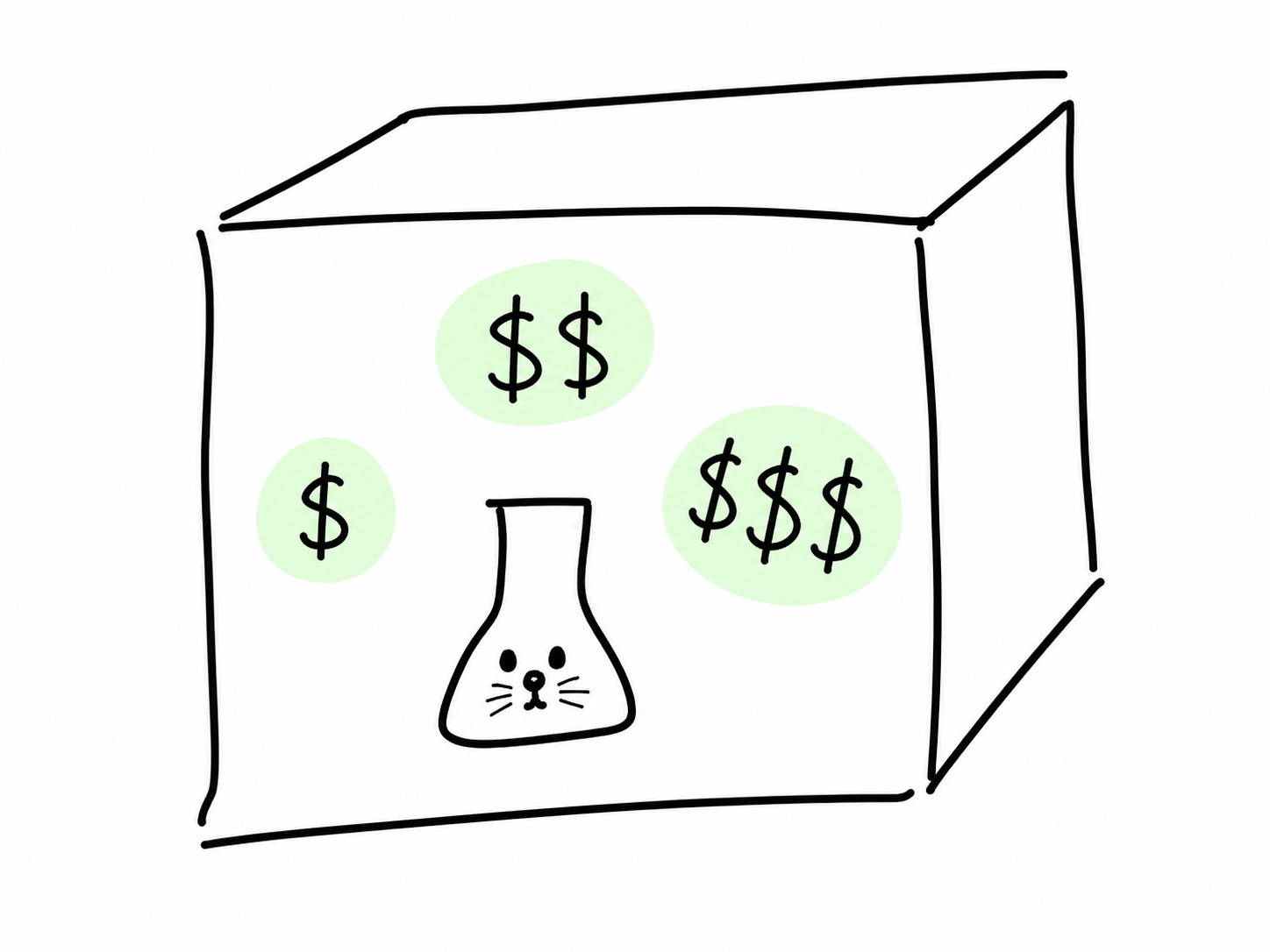
- Goodnotes drawing. Made readable by (Schrödinger’s?) Chat. -
What is always puzzling me most about pricing inside otherwise professional B2B companies. Every one of them will tell you it knows its customers. Customer-obsession is on the slide. There’s a research budget, personas, journey maps, account plans... Then the pricing needs to be made, and the segments on the table are industry & company size, maybe region. The same 3 buckets that came back from a marketing exercise five years ago.
Almost none of the customer knowledge makes it through the door. You could then argue: yes but our sales team knows the market and has freedom to put prices based on willingness to pay. But…
They're (close to 100% of the time) incentivised to sell volume. So they will do whatever it takes to close."
Companies with the most advanced procurement teams get the best price
You never really learn anything
The reason this happens is not laziness. If you segment to decide who to reach via which channel or what message to put into branding, the chances of the same parameters being predictors for willingness to pay are close to 0.
The cost of getting it wrong is not a 1% pricing optimisation. The sales team spends a year chasing a market with no pull while the buyers who would have paid you 3x sit in the next room and nobody knocks on the door. R&D specs the next product for the average of two segments that should have been separate. Finance models a blended margin that doesn’t exist anywhere in the customer base. An investor asks where you’re growing… what you should answer is customer insights, but the answer that gets given is a list of logos, industries, geographies, which tells the investor almost nothing about whether the next ten deals will pay double or half of the last ten.
In deep tech the cost is more extensive, because the market moves much faster. New chips, new architectures, new regulation, new applications. Knowing which slice of the constantly changing market pays best for what you built is crucial.
Some characteristics tell you
how to find your customer. Industry, geography, headcount, public signals like funding stage.
how to talk to your customer. Which application they care about, who sits on the buying committee, what the technical concern of the day is, what their procurement process looks like.
what your customer will pay. What problem they are trying to solve. What alternative they have today, and what that alternative costs them. How much pressure (regulatory, competitive, internal) sits on the decision.
A pricing segment is also almost never one characteristic on its own. It’s a combination. A buyer with one problem and one alternative gets one outcome. The same buyer with a different alternative gets a different outcome. A buyer in the same industry as another but with three times the regulatory pressure is not in the same pricing segment. The segments come from how the characteristics combine instead of picking the best single demographic.
The trick is to do this work early. What you get out is a list of your customer segments, ranked by likely willingness to pay. The top of the list is the segment to chase first. The bottom is the segment to stop spending sales time on. Everything in between is where you can make tough choices.
Then comes the harder question. How do you defend the price differences between segments without leaking the lower price up? That’s what Post 4 was about. Price fences exist for exactly this.
The Pricehiker’s Guide
Our weekly topic to hitchhike towards pricing excellence
Where did our current segments come from?
A marketing exercise, a sales pipeline tidy-up, an investor deck? If the answer is anywhere other than “a value assessment we did recently,” the segments may or may not be the right ones for pricing. Either way, you don’t know.If two customers sit in the same segment today, do they actually have the same willingness to pay? If yes, the bucket is doing the job. If no, the pricing-relevant difference is sitting in a characteristic you have not used yet.
Which three customer characteristics, combined, would predict willingness to pay best? Likely based on the problem the buyer has, the alternative they have today, and what it costs them.
From the lab
This time based on discussions at the conference rather than an old project
Today, we follow a photonic compute company. Novel hardware, no clean comparable on the market. Customers fall into three different worlds. Sovereign research labs running custom workloads. Cloud-services buyers experimenting at the edge of their stack. Industrial integrators putting the chip inside a much larger system they ship to their own customers. The pricing model is one global list price plus volume tiers.
Which characteristics would actually predict what each customer pays?
A short round of questions already shows massive improvement opportunities: Pick three customers from within the “sovereign research lab” bucket.
One has a custom FPGA workaround as its alternative, no real second option. (Field-programmable gate array. No worries, I had to google as well. And yes, I still do that.)
The second is benchmarking against an active GPU reference price.
The third is comparing against a buy-or-build calculation against a much larger BOM.
Three labs, three completely different alternatives, three completely different prices the customer can defend internally. The “lab” bucket told you nothing about what each one will pay.
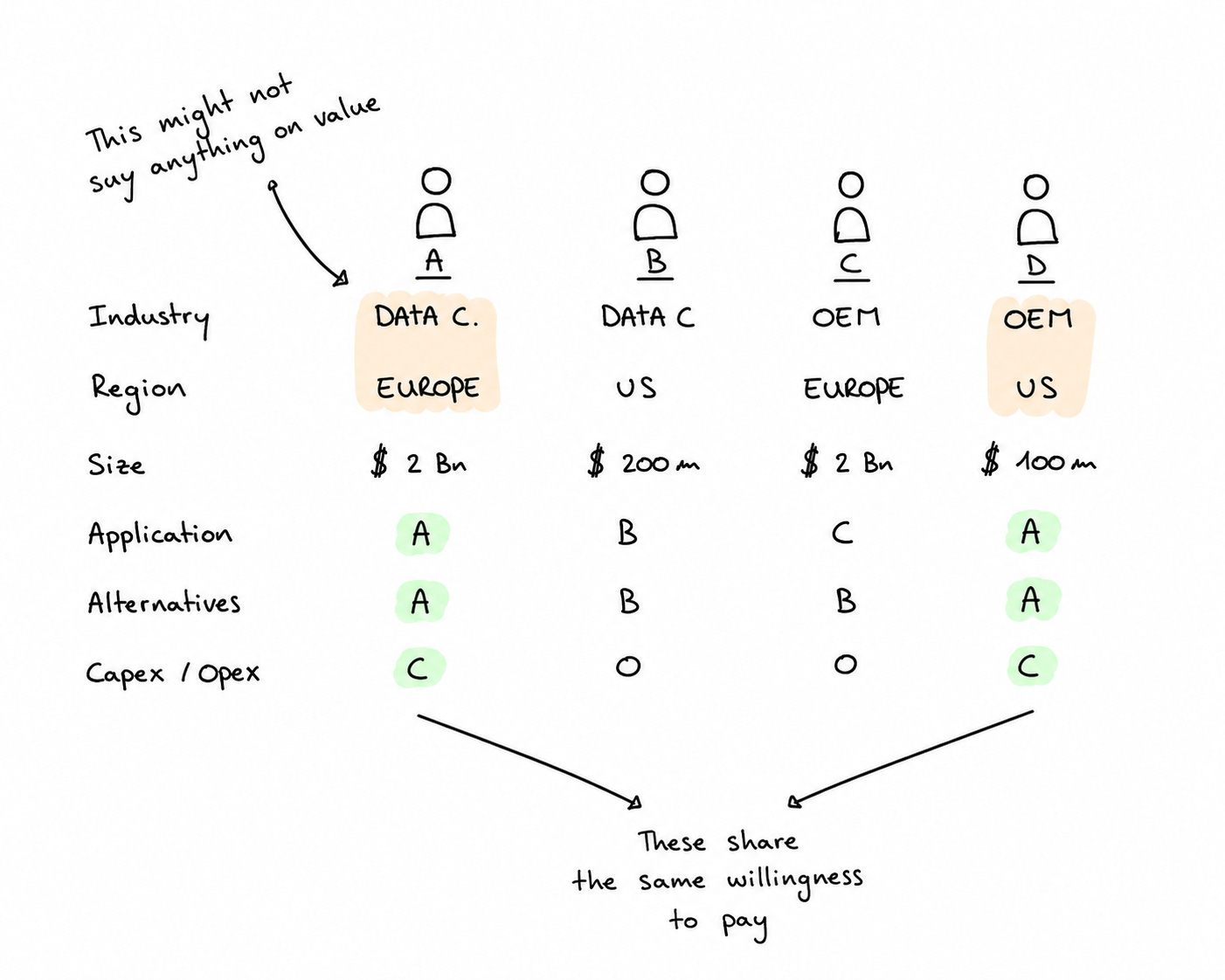
Now do it the other way around. Pick one customer from each of the three firmographic segments. A lab with a GPU comparison. A cloud buyer with a GPU comparison. An integrator with a GPU comparison. Three different segments on the slide. Same alternative. Same anchor price in the buyer’s head. The pricing logic for the three is almost identical, and the “lab vs cloud vs integrator” split has nothing to do with the answer.
For this company, three characteristics carried most of the pricing weight, and none was in the historical segmentation.
What alternative is the buyer comparing against today? Custom FPGA, active GPU benchmark, build-it-yourself, status-quo workaround.
Capex-heavy or opex-heavy buyer? A capex-heavy buyer wants a one-off price, ideally with a volume discount. An opex-heavy buyer wants a usage- or outcome-based model.
What warranty or service shape does the buyer need? Some cloud buyers want minimal warranty and a fast-replacement contract. Some industrial integrators need long-term parts availability written in because the chip is going into a regulated end-product they will ship for ten years.
Grouping based on these 3 in this case has another big upside - you are actually able to defend different price points. A research lab and an industrial integrator can end up in the same pricing segment because they share alternative, capex profile, and warranty shape.
The point of the picture is not that the initial segmentation is wrong. It was built for a different question.
- drawing: same as above -
What’s next
A peek at what’s brewing. Always open for ideas or struggles you are facing!
Two threads from here.
First, outcome-based pricing. Still owed from Post 4, where I called it the S-grade of pricing. The buyer pays for what they actually achieved with your product, not what they took home.
Second, how to run a value assessment without constantly coming back to the same topics. Easy to say, harder to do.
Max also publishes these notes on Substack. Subscribe there, or below, to get the next one in your inbox.