· 6 min read
On competitors, market prices & unrecognized value.
Can you really do something on pricing, even if it seems your market is stuck?
 Max RymenCo-Founder · Pricing
Post 11 · Na · Sodium
TLDR: Pricing is super important, but we can’t do anything about it. We do not know what our competitors charge. Our prices are set by the market. Our customers will not pay extra for the thing that makes us different. Really?
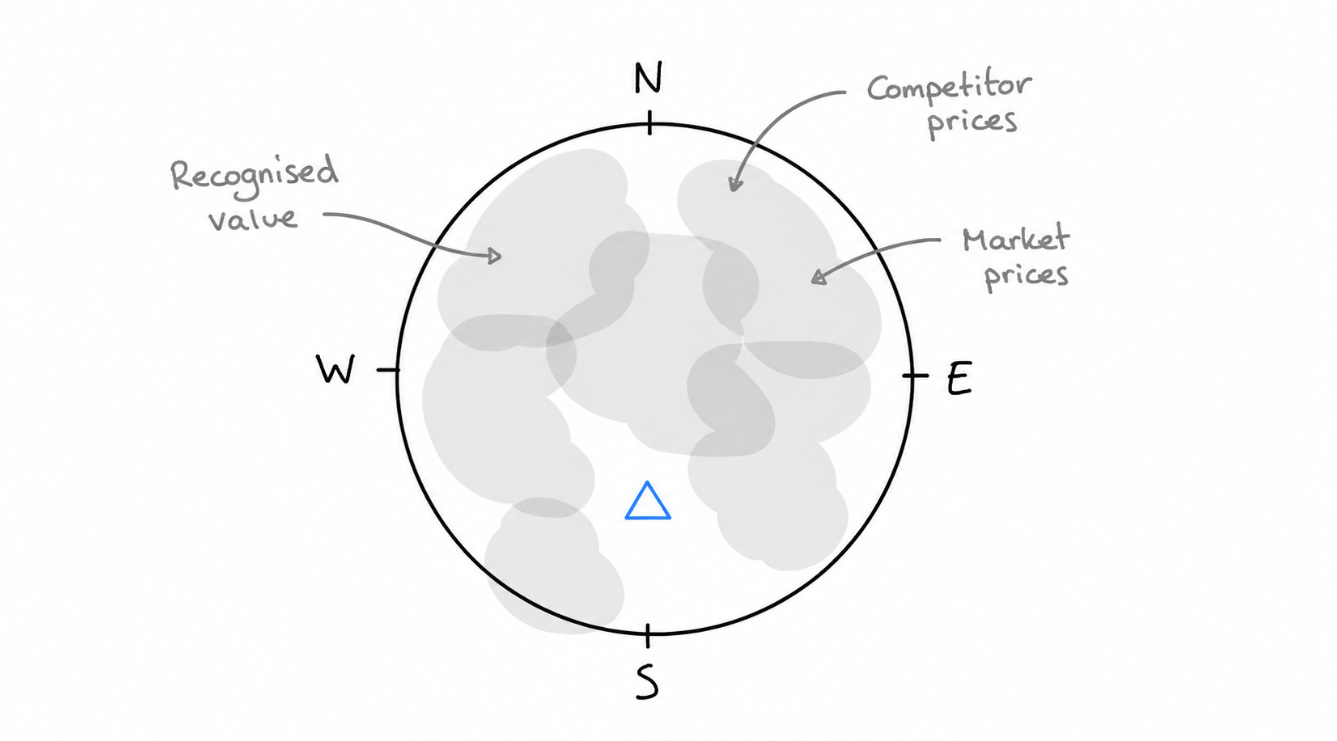
- Goodnotes drawing. Made readable by Chat. -
We do not know what our competitors charge.
Our prices are set by the market.
We know we are innovative, but the customer does not want to pay for it.
If you recognize these, I will try to share some learnings on how you can get started.
Let’s try to think through them together.
“We don’t know what our competitors charge”
That is more the rule than the exception. I do not bring a magic wand, but we might open some locked doors. Alohomora! (really looking forward to Autumn by now)
In most b2b markets nobody publishes their prices and if they do, it’s list prices and not net prices. Quotes also tend to be confidential, and when your salesperson does hear something in a negotiation, it is usually shared by the procurement team of the customer on purpose. What do we want to know, though?
A starting point (focus of this section)
How we compare to that reference (handled in other posts)
Starting point:
Most companies still price on cost plus a margin. That is usually said as a criticism, and here it works in your favor: if their price is tied to their cost, then estimating their cost might get you to a better than random starting point.
What goes into the product, what do those materials cost today, what assembly and testing activities do they likely have to perform…
Picture a company making machine components, with two or three private competitors who never share quotes. They know their own part lasts longer before it has to be swapped. They also know a competitor uses different materials, and they know what those materials have done on the market these last two years, so they can estimate which way that competitor’s cost has moved.
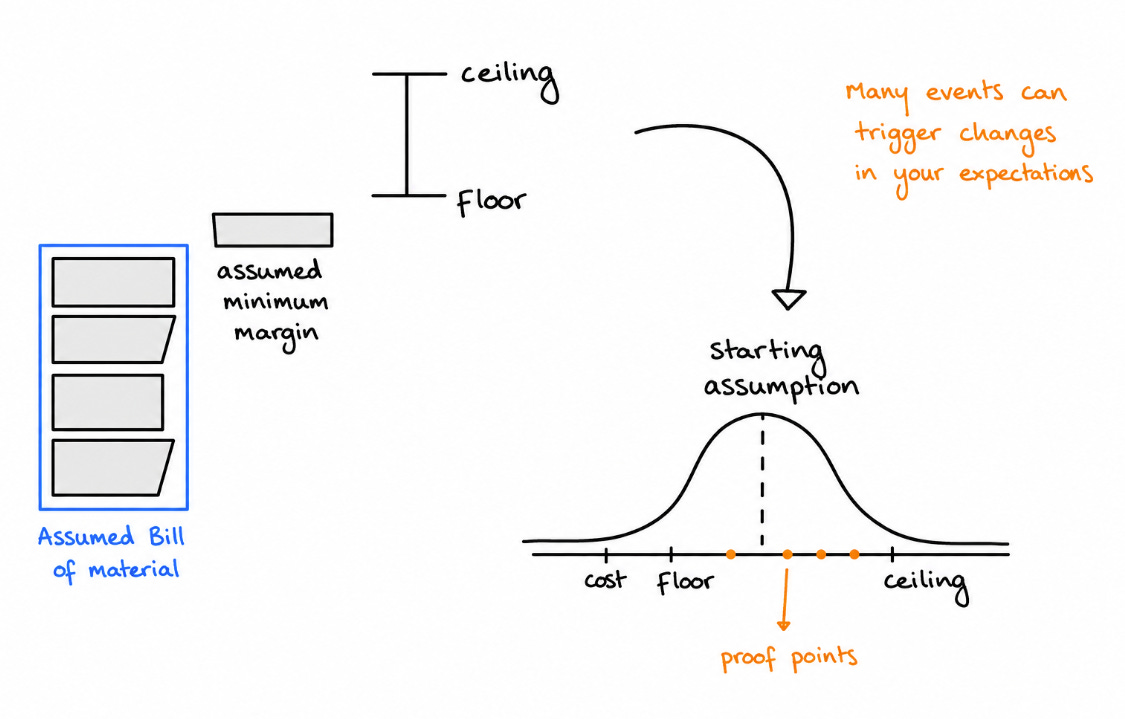
We are uncertain, so let’s put a range around it. What does a company like that need to survive, and what would a very good margin look like? Thin margin on your cost estimate gives you a floor. Strong margin gives you a ceiling.
You can see this visualized in the image below
- Goodnotes drawing. Made readable by Chat. -
Now, let’s start gathering extra information to improve that insight (orange dots in the drawing). Each time you learn something, ask which of three things we become more certain about:
their cost base: e.g., one of the materials they use got way more expensive
their floor: e.g., we lost a deal to them below this price level and we know we are the better product
their ceiling: e.g., we see public annual accounts which highlight higher margins
There is a name for this way of working. It is called Bayes’ rule (used in many scientific applications such as spam filters). It has three parts and the general principle is quite logical: you start from what you believed before, how likely the new fact would be if that belief were right, and what you believe after seeing this new fact.
How we should compare to that:
Knowing what alternatives in the market cost are important, but if you bring innovation: understanding how you are different might be even more important. It would bring us too far today and I have been writing about that already so I am not opening that box today.
“Our prices are set by the market”
Of course they are. But is there really such a thing as “the market”?
Take a coating that gets sprayed onto a machine part. THE market price is around ten euros per square meter. Everyone in the industry will tell you that this is the case.
Now look at two different customers:
The first one coats parts during planned maintenance when the line is down anyway. Whether the coating needs two days to dry or one barely makes any difference.
The second one has to actively stop the production line. That line has a daily output of twenty-five thousand euros, so two days of drying costs them fifty thousand euros.
Of course if all coatings are exactly the same, market dictates the price. But are you going to tell me the second customer will not pay more for a more advanced paint that saves them a day of downtime? If your product really is the same as everybody else’s, the market does set your price. (although even then, you might have organizational differentiators that could be of value)
Now, this is where pricing becomes part of product strategy. Imagine you have a coating that cuts drying time in half, will you put it again in the market at ten euros per square meter while you hopefully capture some market share? Or will you dare to find those customers that are willing to pay for your innovation?
“We know we’re innovative, but the customer doesn’t want to pay for it”
A comment, I hear especially in the sustainable innovation space. Especially given the recent political landscape, often with a certain tone of frustration. We can try to find it, but historically (except in periods of very targeted government interventions) people tend not to pay to avoid negative externalities.
On the flip side, there are many things happening right now, that should catapult these innovations. Some big trends we see in the past months like: fluctuating gas prices, tariffs, self reliance.
Electrification & local supply chains, while initially features of building sustainable innovations might now just be the more interesting economic option.
Do these trends impact you?
Do we know how we create (measurable) economic upside with that?
Does that upside count for the people we are selling to?
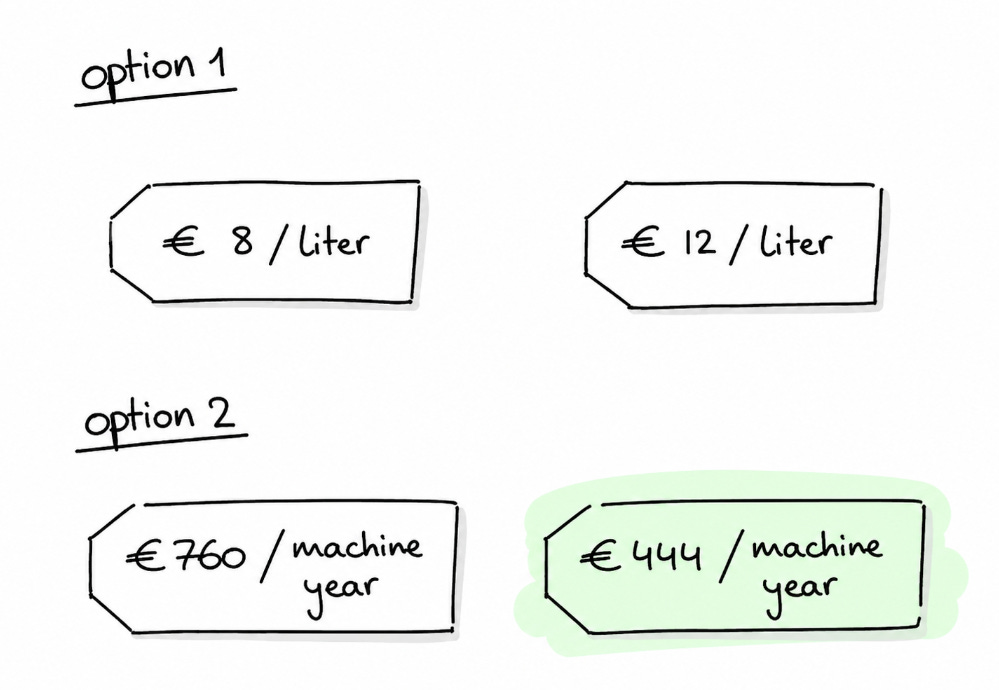
Say you sell a bio-based fluid for industrial machines at 12 euros a liter, where the standard one costs 8.
A machine gets through 20 liters a year of the standard fluid and needs changing twice. The labour cost of a change is 300 euros.
(20 x 8) + (2 x 300) = 160 + 600 = 760
With yours it takes 12 liters and one change.
(12 x 12) + (1 x 300) = 144 + 300 = 444
I think it is obvious that the question here should be whether it makes sense to price per liter.
Why so few companies take the time to think about this:
On problems that look unsolvable
Nobody really thinks pricing cannot be improved. It is more that cost and volume come with a direction, and price does not.
All else being equal, if you can take cost out, you should always do it. With volume it typically works the same way: if you can sell more at the same price & cost, you should do it (it typically even has an add-on positive effect on costs). In both cases one direction is good & the other is bad. Is that what makes it beautiful?
For pricing, it is a bit different. You cannot assume all else being equal, because pricing has an influence on volume. Thus, there is no “good” or “bad” direction. This does not mean it is not optimizable. It is just a more complex problem to optimize for.
My co-founder and I have been using this skill by Matt Pocock called “Wayfinder”, we like to think of it as finding the right way in a foggy map. I think as an innovator, you owe it to yourself to at least clear the fog and understand what you are worth for which customers & make your pricing decisions from there.
Further wayfinding
No papers or books this week, just a 15 minute YouTube clip on the Wayfinder skill & a good old wikipedia page on Bayes.
The wayfinder skill of Matt Pocock:
Bayes’ theorem.
https://en.wikipedia.org/wiki/Bayes%27_theorem
Max also publishes these notes on Substack. Subscribe there, or below, to get the next one in your inbox.