· 8 min read
Everyone Wants Safety. Almost No One Will Pay For It.
Selling solutions to prevent accidents is one of the hardest jobs in pricing.
 Max RymenCo-Founder · Pricing
Post 10 · Ne · Neon
TLDR
All things are not created equal, and so are value drivers. Help a customer sell more and they will (likely) pay you for it. Cut their costs and they will at least run some numbers with you. Safety is a bit of an odd duck: emotionally everyone wants it, but the economics seem to be different…
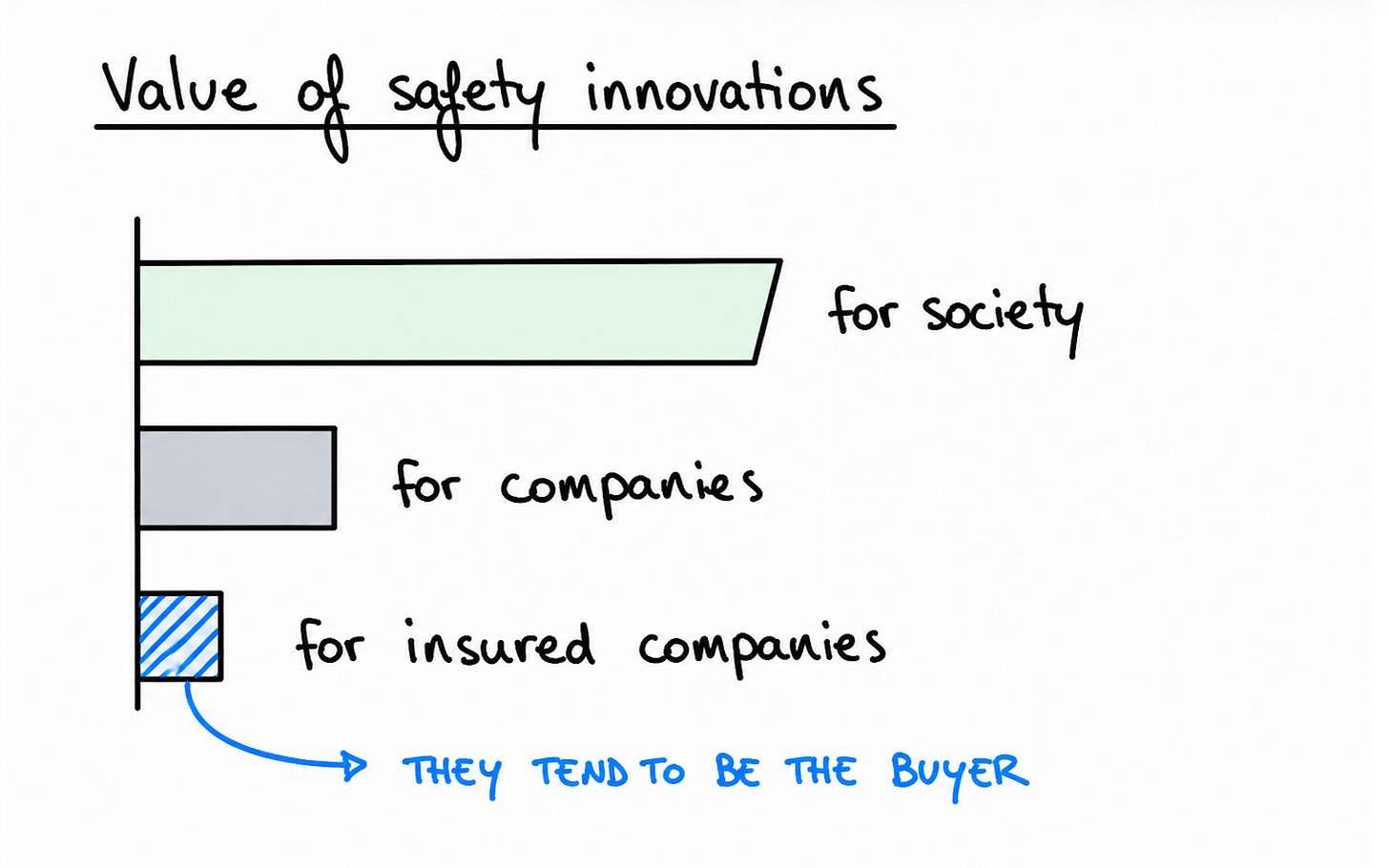
- Goodnotes drawing. Made readable by Chat. -
In Post 7 I promised to write about how to price safety. I do not have all the answers, but at least have gone through the process and did some thinking I wanted to share. (some sensitive or perverse discoveries) Tell me where to improve!
When innovating, people often think about big issues they want to solve. Few of them are as important as creating a safe work environment and so, there tends to be quite some innovation in this space. This should be easy to sell, right? The first time working with such an innovation, I didn’t expect to hear “This could save lives” & “We need to make the business case” in the same conversation. But of course I was wrong as many in this business will recognize… (Safety is not alone in this. Sustainability has a similar challenge: a proven value, but often no buyer)
The simplest explanation is: you are asking a buyer to pay for a harm they barely feel. In the case of unsafe operations, insurance often covers most of the accident as long as there is no deviation from normal business standards. Let’s unpack that problem.
Four questions are typically relevant in any price/value discussion
When a product clearly has value and will not sell, it’s helpful to split it in these questions:
What is it worth? The actual value of what your product changes. (actual value)
Do they see it? Does the buyer believe in this value? (perceived value)
Would they pay for it? Seeing value and handing over budget are not the same. (willingness to pay)
How much of it do you take? Your capture. (price)
It helps to know the answers here to decide where to act - let’s do that for safety.
Question one: what is it worth?
Here, we already run in the first challenge, whose total value are you looking at? Remember who your buyer is.
The big (public) picture number. The impact for society of reducing one fatal risk, scaled up to a full life. The US Department of Transportation currently works with about $14 million per statistical life. This looks very impressive, but is very difficult to realize.
The company’s own number. What one accident costs: stopped production, the investigation, people off work, fines, lawyers. The US National Safety Council estimates about $1.5 million per workplace death (this is a cost-to-the-economy number, so you would have to rebuild it for specific buyers).
The insurance number. These are things like: what they pay in premiums every year, what they pay per incident through the deductible, how new incidents would influence the renewal.
In R&D or funding stages, many pitches work with the first number. That’s of course good for the business case, but not something your buyer feels. When things go wrong they more likely pay a deductible.
Question two is typically fine, Question three is often a problem.
Do they see the value? With safety, yes, immediately. I have never had to convince anyone that fewer accidents are important. For readers of Post 7: the heart door swings open very soon.
Would they pay for it? When more of the potential loss is carried by the insurer, the rational part of the buying process will work less. Economists have called this moral hazard. Behavioral research adds to that: most people prefer gambling on things not happening over paying a sure cost to avoid it, and they dislike partial protection. (often your solution does not reduce risk to zero)
That’s the bad news, what can we try to do about it?
Better communication helps, a little
For a long time already, studies have found that naming the odds of an incident will lift what people will pay. Describing the same offer as what you lose by not acting, rather than what you gain, increased how many customers took it (see a study from the year I was born). For a safety pitch that means explaining the incident frequency and talking about a €200k downtime bill your customer is already exposed to. Doing the research on economic value does matter!
Safety has no average buyer
People do not pay average amounts for prevention. Few people are willing to pay anything at all for prevention. But the ones who pay, tend to pay above average.
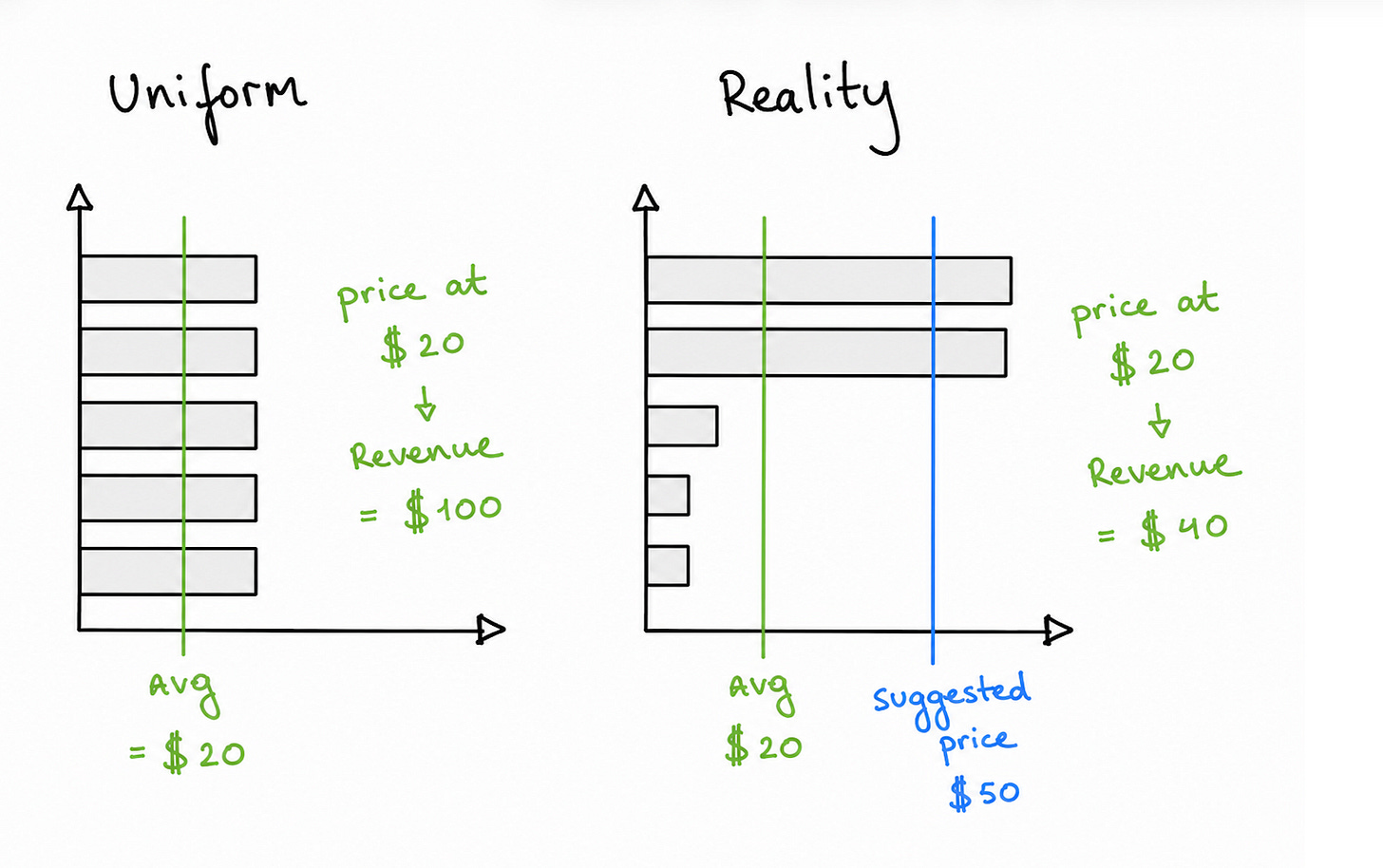
The market for avoided harm splits into two camps: a big one at zero, and a smaller one well above the average. The visual and explanation below could be your business:
- drawing: same Goodnotes treatment as above -
Say your product creates €100k of value a year. In a market where willingness to pay sits fairly evenly around 20% of that value, if you price near €20k, most buyers would convert.
In the case of safety, it often looks like most buyers are at zero and a small camp of believers around €50k. The average can still be around €20k, but that would be the wrong price to set: the zeros will say no, and the believers pay much less than what they were ready to pay. With safety, you either capture value from the believers or from nobody. (which could also be a tactic - Volvo did that by giving the patent of seatbelts away)
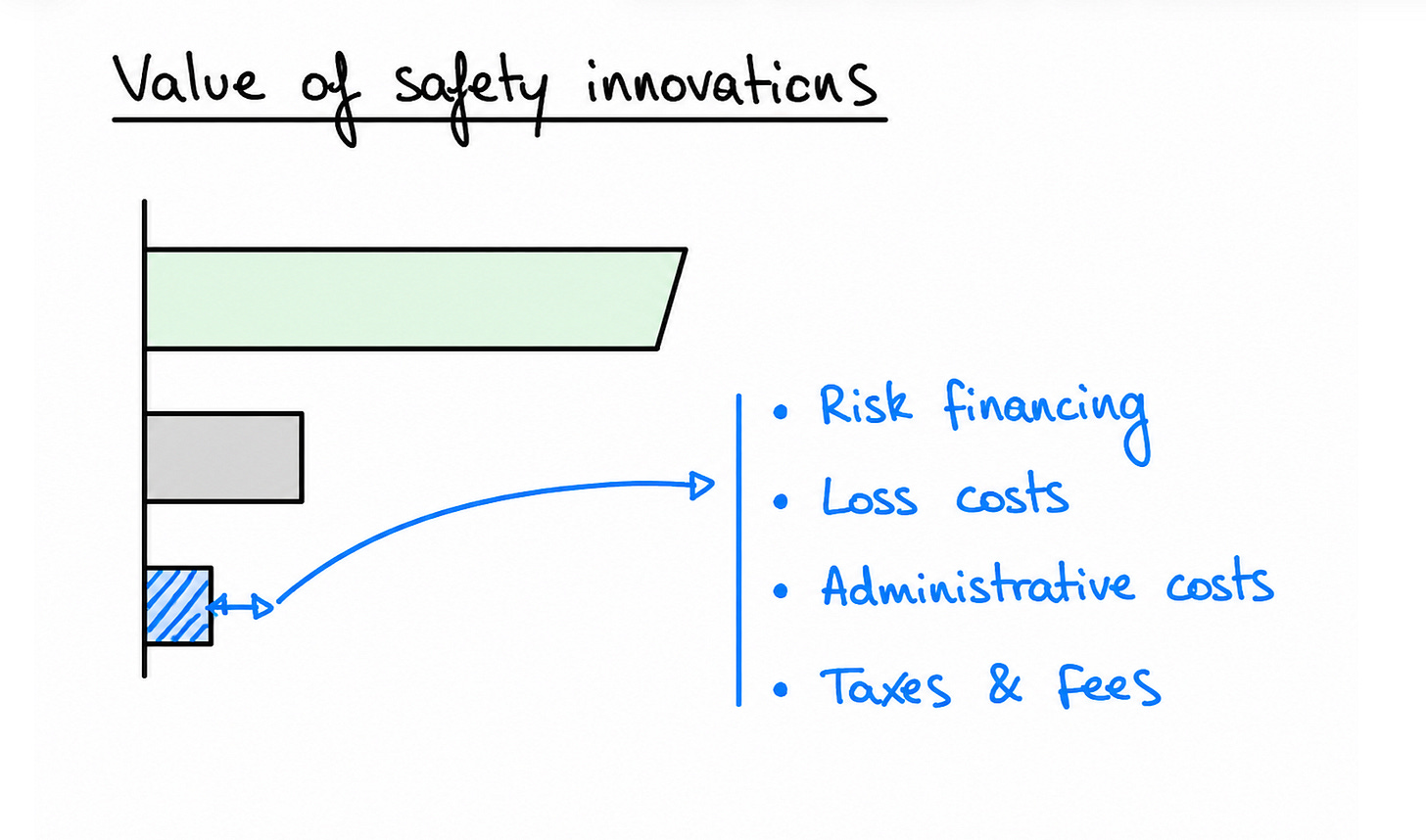
Find out if there is a way to take a slice of the cost you remove
If your product lowers a buyer’s Total Cost of Risk (see below), your price can be a slice of that saving. It is a way to let “We’re insured for that” not be a blocker. There apparently is a KPI risk managers are judged on called:
Total Cost of Risk:
Risk Financing Costs: Includes all insurance premiums, broker commissions, and captive insurance contributions.
Loss Costs: Encompasses both direct costs (deductibles, claims payouts, uninsured losses) and indirect costs (business interruption, lost productivity, overtime to fix damaged equipment).
Administrative Costs: Operational expenses dedicated to risk management, such as safety training, compliance initiatives, third-party claims administrators (TPA), and legal fees.
Taxes & Fees: Regulatory fees, surplus lines taxes, and assessments attached to risk transfer.
As always with outcome-based pricing, it makes a lot of sense but is difficult to realize
We come back to tracking the right characteristics
We already discussed that the buyers are not evenly distributed. This may sound obvious, but this means you need to sort your buyers by who actually pays when it goes wrong, and note how little that map matches your marketing segments (See post 6). Some characteristics that might be worth tracking:
Self-insured operators and buyers with big deductibles.
Buyers whose safety record can block their revenue. (e.g., In heavy industry, contractors get prequalified on safety statistics; a bad record can disqualify them from bidding.)
Buyers under a rule. When regulation steps in, we start looking at compliance alternatives & change the pricing game we play.
Another one can be found in the example from the lab
Be prepared to make more than an economic choice when you bring safety innovation to the market
Based on what we discussed: pricing safety in an economic optimal way might mean you are serving only a small numbers of buyers. This can result in keeping a safety product away from many people who would benefit from it. An interesting challenge to be solved
The Pricehiker’s Guide
Are you innovating in safety? Start your commercial journey with these 3 questions.
Follow the money from a couple of the last incidents that happened in your space. Trace who paid what: deductible, downtime, fine, lost future bids, stock market impact, ...
Next to the emotional points, do you have your CFO-responses ready? Especially on the question: are we not insured for that?
Figure out where we see the biggest drop. (also very relevant for non-safety innovations)
- Total value
- Perceived value
- Willingness To Pay
- Price
From the lab
A real case. We changed enough to keep everyone comfortable.
Regular readers might remember the safety product in Post 7’s lab section. We take this case again, but now with our value of safety goggles on:
A global leader in logistics products had built something that made day-to-day operations much safer. A safeguard for the worst type of accidents in the industry.
The initial pitch was:
# incidents avoided per year across a fleet
$M per major incident
Resulting in payback in 3 months.
The most common answer: this is really cool, but we are insured for that.
This does not mean “game over”, it just means your preparation needs to be better:
What is their deductible per incident?
What amount of downtime days does the insurance cover?
In which segments is this always too low?
Do we know which buyers need an absolute spotless safety record to do business?
- drawing: same Goodnotes treatment as above -
The challenge remains that for new technology, insurers & government will typically not commit to be part of the solution without a high sample size. (difficult in low probability, high impact events)
Choosing the right segments that were willing to pay early, allowed for financial breathing room - time to gather proof points & then support from insurers and government to make the case for the long tail as well.
What’s next
A peek at what’s brewing. Please share if you have specific topics you would like me to write about!
Things on my list:
Outcome-based pricing done properly. Trying not to burn my fingers on this one, but there are definitely great guidelines to follow!
Pricing when the rules change. Regulation (especially in Europe) has a tendency to change quite a bit: carbon prices, liability shifts, mandatory standards. The companies that price well through a rule change can take advantage over their alternatives.
For the avid truffle hunters!
Good places to keep digging.
Viscusi, W. Kip (2018). Pricing Lives: Guideposts for a Safer Society. Princeton University Press. Book on how lives get valued and (mis)priced.
Mankaï, Marchand & Le (2024). Valuing insurance against small probability risks: a meta-analysis. Journal of Behavioral and Experimental Economics. We discussed for example that explicitly stating the probability out loud can increase willingness to pay.
Wolff, Larsson & Svensson (2020). Willingness to pay for health improvements: prevention versus treatment. Value in Health. The study behind the non-uniform distribution of willingness to pay.
Max also publishes these notes on Substack. Subscribe there, or below, to get the next one in your inbox.