· 5 min read
Firepower, colours or status?
Lessons from Fireworks about Pricing
 Max RymenCo-Founder · Pricing
Post 9 · F · Fluorine
TLDR: Most companies can tell you exactly what their product is made of. The engineering, the specs, the cost to build, the years of work inside it. Then they price on all of that and wonder why buyers haggle. A story a bit closer to home, as my grandfather and his brothers were pioneers in fireworks.
The three brothers made fireworks. Not the small boxes you can buy in local shops, they were pioneers in creating big firework shows and performed around the world. I am fairly sure that almost anyone in Belgium born before 2000 has, at some point, looked up at something my grandfather and his brothers built, lit, and orchestrated (on music, which was one of their inventions).
To do something a bit different than the previous posts: today you will not only learn about pricing, but also about fireworks!
Fireworks 101
Probably my first school presentation in elementary school - same for my brother and all nieces and nephews.
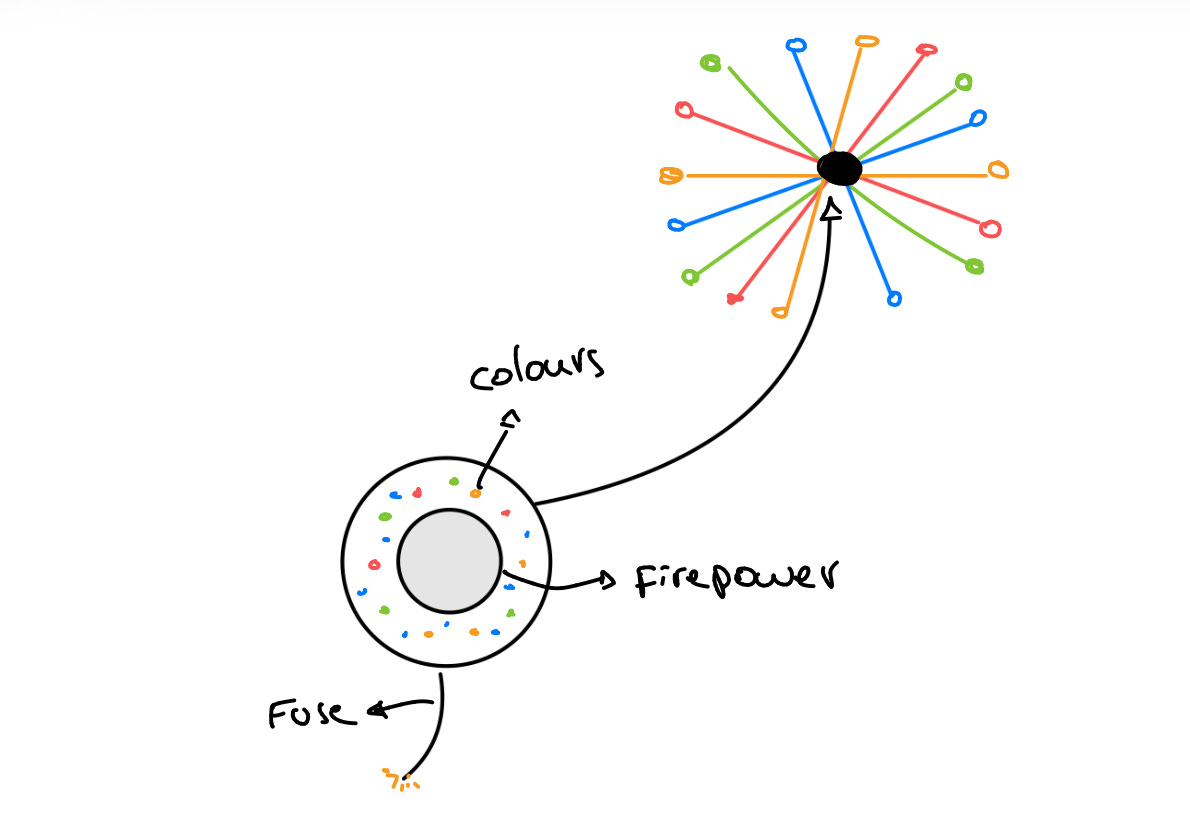
Goodnotes drawing: a bit more artisanal - so no rework by chat
Strip a shell down and there are three parts:
There is the fuse:
The thing you light. It does nothing impressive on its own, it just decides whether anything happens at all.There is the firepower:
Black powder that throws the shell hundreds of meters up and then bursts it open at the top. It is most of the weight, and most of the danger. It is also cheap, roughly the same commodity in every shell, and completely invisible once it has done its job.And there are the colours.
Tiny pellets, called stars, packed with metal salts: strontium burns red, copper burns blue (a good blue is hard to get apparently), barium green, sodium a gold-yellow. These are the fiddly, skilled, expensive part. They are also the main reason most people are coming to watch.
The firepower is everything that has to be true for the show to happen at all: the engineering, fail-safes, permits, logistics of getting a truck of explosives to the right field (or even boat) and setting it off without hurting anyone. It is most of the work and most of the cost, and no one should see any of it.
The colours create the astonishment in the crowd and maybe more importantly: the prestige & credit for organizer. very few are interested in the chemistry.
Talking through it for fireworks makes it sound logic. Most companies (yours included?) base their price on the firepower part, because it is what they can measure from the spec sheets, bill of materials & hours.
Nobody can sell tickets to the sky
Now, while it’s a show, have you ever paid for one? The audience never does, you cannot put a fence around the sky. Anyone within a few kilometers gets the whole show for free. Economists have a name for this, the public good, and fireworks are the textbook example.
Two things need to be true:
Non-excludable: If a city or private company puts on a spectacular display, anyone nearby can watch it from their backyard or a public park without paying a direct admission fee.
Non-rivalrous: One person enjoying the show doesn’t prevent their neighbors from watching it at the same time.
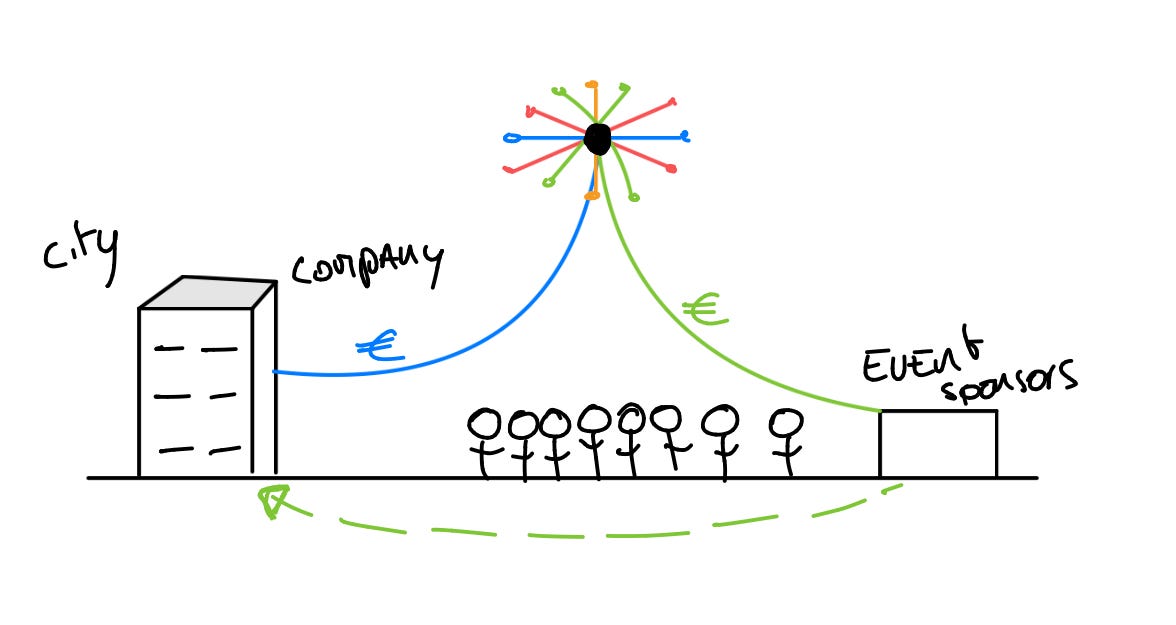
So what happens:
The crowd pays nothing.
The city or organizing company pays for the civic pride (more emotional) and the packed town center (more economical).
The potential sponsors pay for attention.
A really important question in pricing “what should the number be?”, but often it should be “who could I charge?”. If your product throws off value to people who will never pay you, it will not be solved by playing with your price level. When you cannot fence the sky (read more on fencing here), do what the fireworks business does: stop trying to bill the crowd, and go find the city.
The build-up and the bloemekée
A real show (as our family business made them) is not a pile of explosions. It is a story with a slow open, a couple of swells, deliberate peaks, and then the finale, the part we call the bloemekée (Finally some Antwerp dialect in my blog: basically - a bouquet of flowers).
Everything is engineered toward a few peaks and those last sixty seconds.
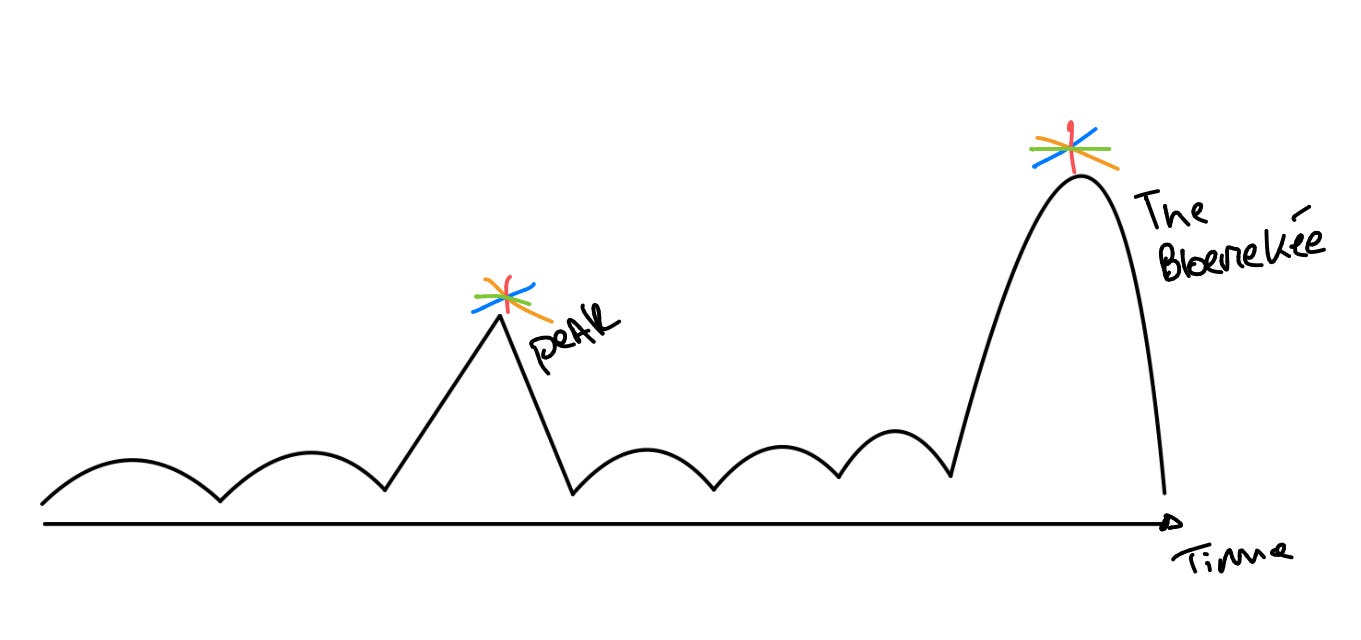
For those into Behavioral Economics: it is what Daniel Kahneman called the peak-end rule: we judge an experience by its peak and its ending, and more or less ignore how long it lasted. A shorter show with a great bloemekée beats a long one.
Buyers remember your product the same way. Not as an average over thirty-six months, but as a few peaks (the day it saved them for example). Willingness to pay often goes up in those moments. So stretching the boring middle, adding features nobody will remember, mostly just adds cost. Find your bloemekée and make it a blast!
Some buyers count, some buyers feel
A show like that does not get bought by one person.
Someone wants the town to gasp: the mayor, the brand, whoever takes the credit for the show.
Someone else has to defend spending significant budget on twenty minutes of action. They will need the economic rationale of such an event.
A lot of pricing picks a side: sell the value and the feeling, or build the airtight business case. In reality the person chasing the emotional value still has to put a number in front of their own boss or finance team. On the other hand, the one guarding the money is usually more moved by the firework than the spreadsheet, so do not only stick to the math with them.
More reading on this, here
The Pricehiker’s Guide
For those who are inspired to work on their pricing.
When your happiest customer describes you to a colleague, what would they remember from:
Inside the box (firepower) - list 3
Outside - what they felt and remember (colours)? - list 3
Who watches your show for free today, and who is the city or sponsor you could be charging instead?
In your last deal, who in the room needed the number and who needed the story?
What’s next
A peek at what’s brewing. Unless you prefer something similar to this one!
Back to the regular pricing diet. Two from the list I am chasing:
The teams that build the hardest-to-copy products are often the worst at pricing them. Clear differentiation, high barriers to entry, and still underpriced, because the people who built it are engineers, not commercial operators.
Pricing a first-of-a-kind unit. No comparable, no benchmark, no history, and a buyer with no reference point either. The hardest pricing problem I know, and a common one in deep tech and industrial hardware.
Where we validated our truffles
Not proof. Just good places to keep digging.
Paul Samuelson, “The Pure Theory of Public Expenditure,” 1954.
Daniel Kahneman, Thinking, Fast and Slow, 2011. The peak-end rule, and the gap between the experiencing self and the remembering self. The colonoscopy study is interesting!
Good old wikipedia or fireworks - check it out!
Max also publishes these notes on Substack. Subscribe there, or below, to get the next one in your inbox.