· 5 min read
The Prerequisite Nobody Mentions
The question that makes or breaks pricing based on value
 Max RymenCo-Founder · Pricing
Post 1 · H · Hydrogen
TLDR:
Some words are over-hyped and (unfortunately) value-based pricing has become one of them.
It comes down to this: If you can't describe your differentiation in one sentence without using the word "better," you probably don't have a value-based pricing opportunity. You have a positioning problem. And no amount of willingness-to-pay research will fix that.
Before building any pricing model, figure out:
where your differentiation lives (it might not be in the product),
whether it’s quantifiable, and …
whether the buyer cares enough to pay for it.
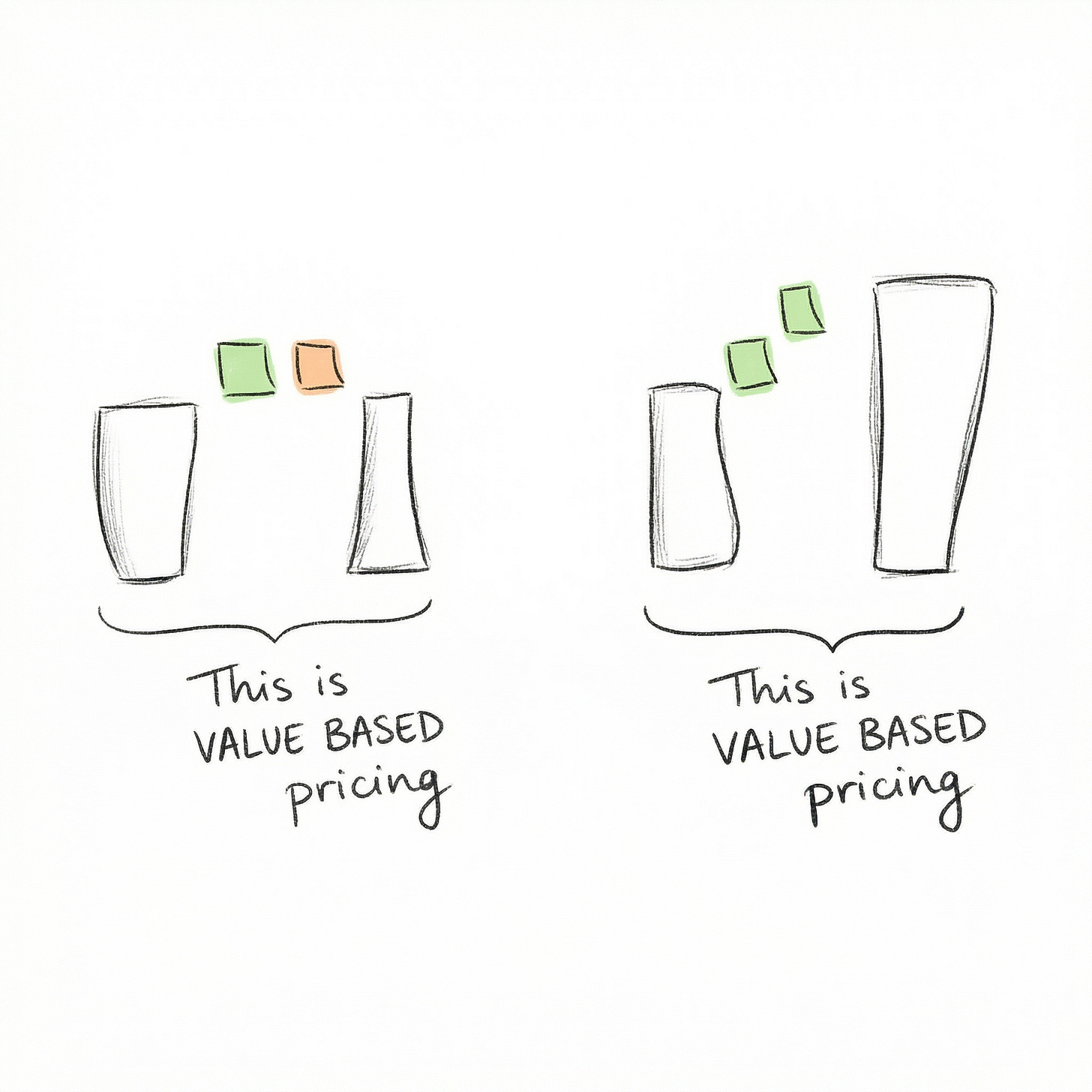
- drawing: made on my Goodnotes and made readable by Nano Banana -
Every pricing conversation I’ve been part of in the past 8 years, someone in the room says it: “We need to move to value-based pricing.” Heads nod. Here’s the part that rarely gets said out loud: there is a prerequisite that most companies skip. Surprise, surprise, … you need to actually be differentiated.
If you’re not meaningfully different from the next-best alternative your buyer is looking at, value-based pricing just collapses into competitive pricing. You can call it value-based. You can build the models. You can run the willingness-to-pay studies. But if your buyer can get roughly the same thing from someone else, the “value” you’re pricing on is identical to theirs, and you’re right back to matching the market.
This isn’t a criticism of value-based pricing. It’s the opposite. It’s taking it seriously enough to ask whether the foundation is there before building on top of it.
Ask the team: what does our buyer do if we don’t exist? That’s the next-best alternative. Then: what specifically do we do that the next-best alternative doesn’t? And I mean specifically. “Better quality” is not an answer. “We deliver within 48 hours to any site in Northern Europe, and our closest competitor averages two weeks” is. (It might not be the right strategic choice, … but that’s a different discussion.)
If nobody in the room can answer that second question in one concrete sentence, you don’t have a value-based pricing opportunity yet. You might have a product development problem, or a positioning problem, or a segmentation problem. Any of those is worth solving. But building a pricing model on top of “we’re generally a bit better” is a waste of time.
I’ll be honest: I figured it out by running a value-based pricing exercise early in my career where the team spent three weeks building an economic value model, and the differential value column came back almost empty. We could argue a 5% premium, maybe 8%. That’s not nothing, but nobody in the room could defend the inputs. We’d picked the wrong alternative to compare against for half the segments. The buyer didn’t see the same differences we did.
Best case, teams figure this out themselves early. Worst case, they’re already six figures into a consulting engagement before anyone’s done the groundwork.
Very practical - a pricehikers guide, if you will:
That experience changed how I approach every engagement since. Before I touch a pricing model, I run three napkin questions:
What does the buyer do if we don’t exist?
What specifically do we do that the next-best alternative doesn’t?
(One sentence. No “better.”)Does the buyer care about that difference enough to pay for it?
If you can answer all three with specifics and numbers, you have the foundation. If you can’t, the project you actually need is a differentiation audit, not a willingness-to-pay study.
From the lab
A real case. We changed enough to keep everyone comfortable.
A company selling industrial products across global markets. Multiple competitors, overlapping product lines, price pressure from all directions.
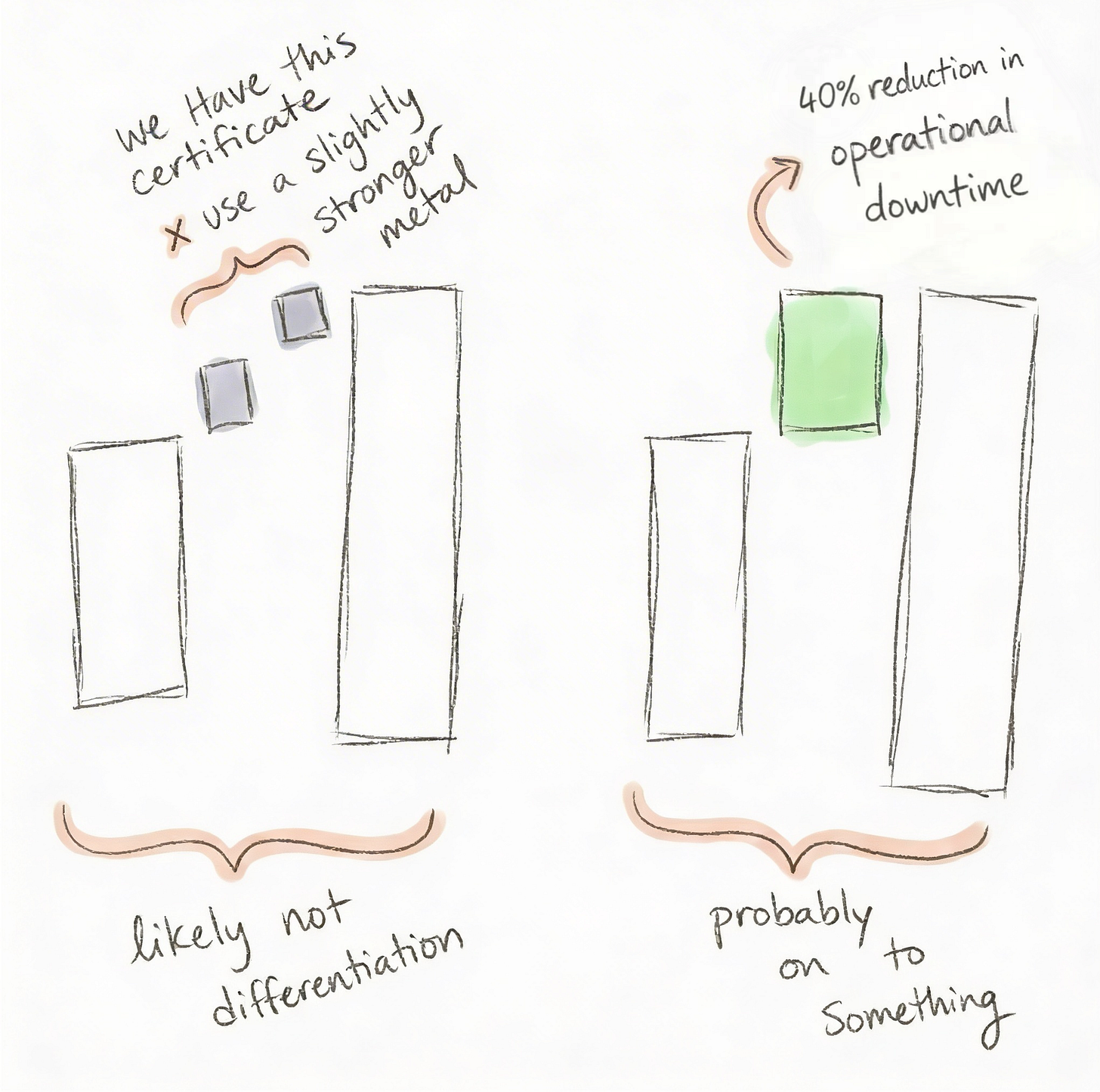
When we mapped their value proposition, the natural starting point was the product itself: features, specs, performance. There were differences, but nothing dramatic. Nothing that would make a buyer pay 20% more without a second thought.
The differentiation was somewhere else entirely. This company could get product to the right location, on time, consistently. In their industry, a late delivery wasn’t a minor inconvenience. It meant shutting down operations.
Downtime cost their customers tens of thousands per day. That reliability was worth real money, but it had never once entered a pricing conversation. They’d been competing on product specs in a market where the product was table stakes and the logistics were the actual differentiator.
This one insight changed the whole journey afterwards: different customer types had very different exposure to downtime risk, which meant very different willingness to pay for reliability.
That’s where pricing on value actually works: when you can point to something specific that you do differently, something the (or some!) buyers care about, and put a number on it. The point isn’t that every company needs a unique product. It’s that you need to know, specifically, where your value lives. And “we’re generally pretty good” doesn’t cut it.
- On the drawing: same as above -
What’s next
A peek at what's brewing. Unless you've got a better idea.
Two threads follow from this:
First: why is differentiation so valuable in the first place? It’s the only part of your offering that can be priced on value rather than on competition. Everything undifferentiated gets competed away.
Second: value-based pricing isn’t an end state. Getting clear on your differential value should feed back into your decisions on value proposition, R&D priorities, and where you invest. Pricing as a trigger for strategy, not just a result of it.
More on both in upcoming posts.
Where we validated our truffles
We see it in the field. They proved it in the papers. Funny how often those match.
Hinterhuber, A. (2008). Customer value-based pricing strategies: Why companies resist. Journal of Business Strategy, 29(4), 41-50.
The core paper on the gap between believing in value-based pricing and actually doing it. Found that 80%+ of companies still price on cost or competition. The key barrier: inability to quantify differential value.
Nagle, T., Müller, G. & Gruyaert, E. (2023). The Strategy and Tactics of Pricing: A Guide to Growing More Profitably. Routledge.
The reference text on economic value estimation. Their framework (reference value + differentiation value = economic value) is exactly the model described in this post. If your differentiation value column is thin, your pricing model will be too.
Thanks for reading! Subscribe for free to receive new posts and support my work.
Max also publishes these notes on Substack. Subscribe there, or below, to get the next one in your inbox.