· 7 min read
Recurring Revenue Does Not Have to Be a Subscription
And confusing the two is how good hardware companies talk themselves into the wrong model.
 Max RymenCo-Founder · Pricing
Post 8 · O · Oxygen
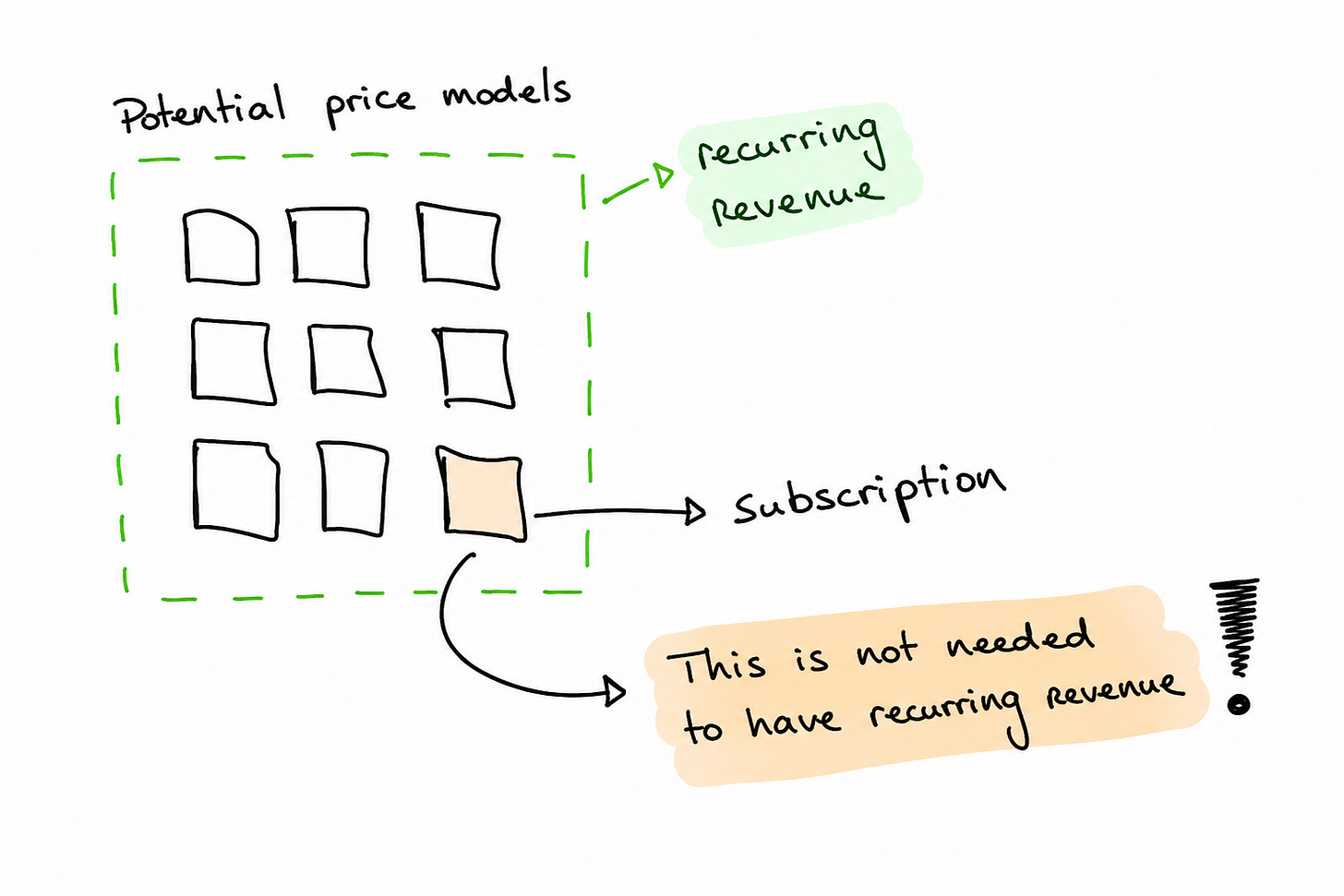
TLDR: Your board wants recurring revenue. So do I, it is a good thing to want. But "recurring revenue" keeps getting heard as "put the product on a subscription," and for a hardware company that is (almost always) not the answer.
- Goodnotes drawing. Made readable by Chat. -
I was chatting with A founder I know quite well last month & he gave me the next blogpost topic. Not really a board meeting, but the advice/instruction he had received was simple: you need to offer the product on a subscription within the next 12 months. He builds hardware, where one unit takes two years and a pile of cash before he can get it in the hands of a customer. And I understood the investors completely. Everyone wants recurring revenue now, and they are right to want it.
But… do you want recurring revenue, or do you want a subscription? People say them in the same breath, and they are not the same thing. Recurring revenue is any money that keeps coming back: a service contract, consumables, (software) subscription, support. A subscription (one form of recurring revenue) is renting out the product itself and collecting the money over time. You can have plenty of the first without doing the second (Not to fall into the “do it like Apple” trap, but… Apple sells you the iPhone outright and still makes a fortune on the services around it. You could even argue that the 2-yearly purchase of your upgraded iPhone became a recurring revenue stream). It is by fixating on subscriptions when talking about recurring revenues that a lot of hardware companies struggle.
It helps to know why software went to subscriptions in the first place, because the reasons were good ones, for software.
Updates (basically new versions of the product) could ship continuously instead of in big paid launches.
The cloud made metering easy.
The revenue smoothed out and investors paid up for it.
And obviously: A second copy of software costs (almost) nothing to make.
A physical product does not work like that. Every single unit costs money to build, and you pay that bill before the customer pays you. So “let them pay over three years” means something completely different for you. You are not spreading out free copies, you are fronting the cash for a machine and waiting years to earn it back. Do that across a growing order book and you need some really good financial engineering. The better the subscription sells, the more machines you are fronting at once, so your best month for sales becomes your worst month for cash. To cover the gap you raise external funding again (dependence on investors?!).
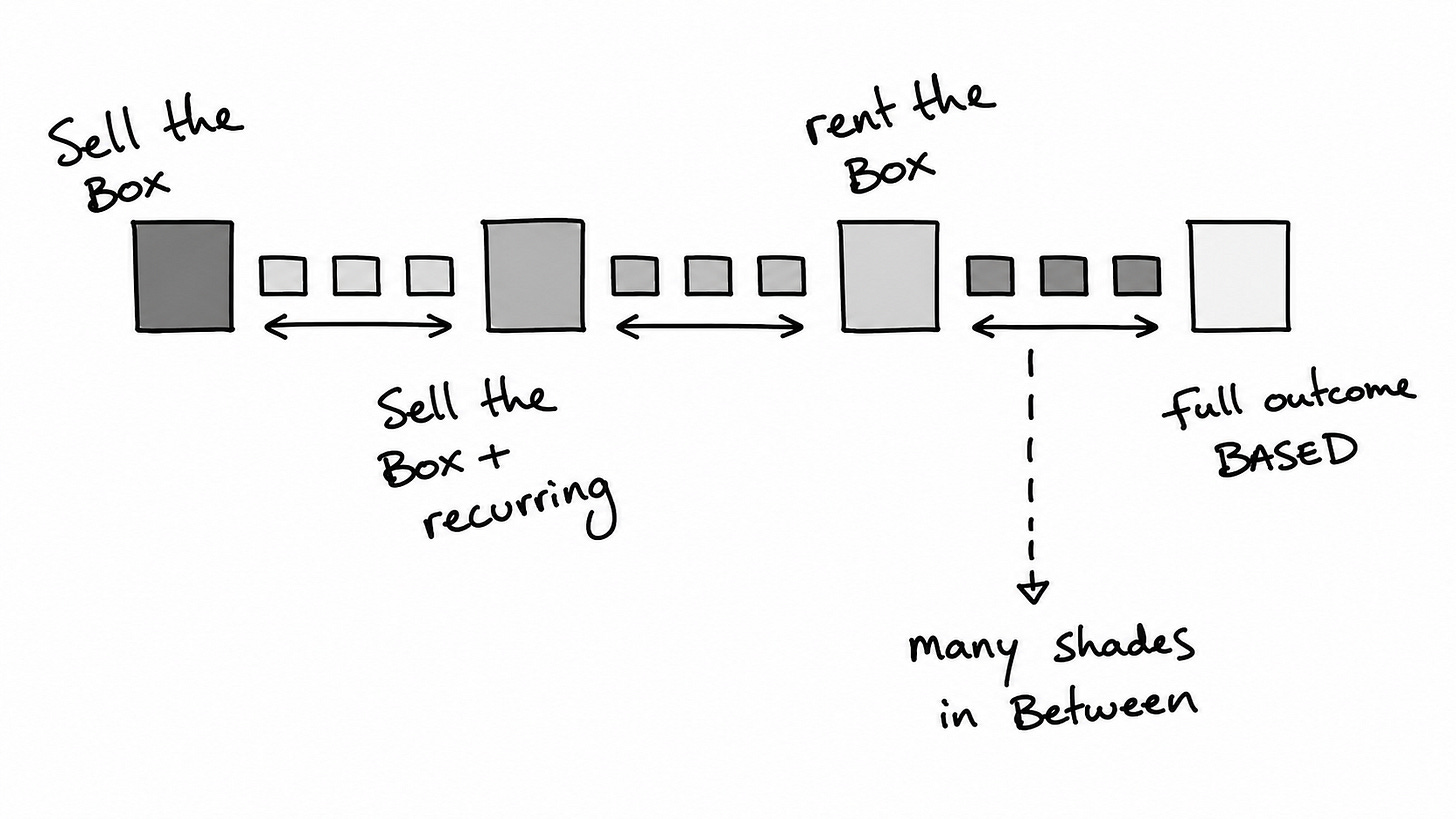
So the reality is a whole range of options. On one end you sell the box and you are done (1): money comes in early and your risk is low. One step over, not yet a full subscription, you still sell the box but charge a recurring fee for the parts that keep delivering (2): the software, the data, a service contract, consumables, support. You keep the cash that funds the next unit, and you build recurring revenue on a layer that genuinely brings value over time. Further along, you stop selling the box and start renting it (3), the way Hilti does with construction tools. A contractor pays monthly to always have working tools on site, repairs and replacements included. It works well, and the reason is worth a look: Hilti is a century old and can comfortably carry a fleet of its own equipment on its own balance sheet. Can you? At the far end is outcome-based pricing (4), where you charge for the result, like Rolls-Royce charging airlines per hour their engines fly. It is the most obvious match of price to value and the hardest to run, because you carry the most burden of all.
The further along that range you move, the more you take on: more cash fronted, more things you need to be really good at.
You could argue the cash gap is a solved problem. But it gets expensive: cheap money goes to companies that are already bankable, which is something innovative hardware companies usually are not.
And even when you can pull it off, it does take something really important from the team: attention. Is turning yourself into a financing/fleet operation the best use of your unique skills? And now we come to pricing… is it adding lots of value to your customers?
Unfortunately, there is lots of judgement that goes into this decision, so I cannot be so opinionated as to say no one should run a subscription. I can say that I think too many are pushed into it, without having all the information at hand. Look at when the value actually reaches the buyer, what their next best option lets them do and pay, and when they would rather pay you. Then take the simplest model on the range that still captures your value, because every step past it costs you cash, risk and focus you could be spending on the product. Because this is such a strategic choice: a longer guide to the profit galaxy…
The Pricehiker’s Guide
Our weekly topic to hitchhike towards pricing excellence. If you are bringing a physical or hybrid product to market, pick one and take a couple of minutes to go through this.
After the box is installed, what does/should the customer get from you every month?
Things like usage insights, optimization ideas, connectivity, consumables.Mark which items are ongoing value.
Uptime, updates, consumables are result they can (and likely will) measure. Some others might be things you really need to challenge.What is the buyer’s next best alternative? (the most important question in pricing as you might have noticed)
How do they pay for it, all at once or over time?When would the buyer actually prefer to pay, and why?
Their budget cycle, their cash, their nerves about a new supplier.If you would spread your price over three years, how would you fund the gap between building the unit and getting paid?
Your own equity, a debt facility, a leasing partner. Work out the cost of that capital.Would the model actually make you more profitable? Not just more predictable money?
Will it win you customers you would otherwise lose?
Is the buyer willing to pay more in total over the years than they would in one go?
Does it raise customer lifetime value?
Does it lift net revenue retention, through less churn or more upgrades to new versions?
Does what it brings in cover the cost of the capital you are fronting?
… and likely some specific versions relevant for your industry
From the lab
Two examples. One where I thought leaning into recurring was the right choice & one when where I thought it did not
Fictive company one: Combu. They sell measurement kits to utilities, with a payback you could prove immediately. In a certain region, however, deals went through the first stages but kept delaying when they arrived at capital approval. Champions on the client side of course asked to drop the price. Of course we did not do that :). We changed the model instead, financed the hardware and put a monthly fee on the data and the service for which there anyhow was budget set aside. A good example where it DID make sense to change.
Fictive company 2: Inert, is the more useful story, because here a subscription was the wrong answer. They make a machine that analyzes and speeds up a production line. You install it once, the line runs faster, and after that the company does very little for the customer: nothing to resupply, no data anyone would pay for. An investor still wanted them on a subscription. They still changed the set-up and all it did was make them pay for every machine up front and wait years to earn it back. (explaining that the exciting model is the wrong one is not my favourite part of the job)
What’s next
A peek at what’s brewing. Unless you’ve got a better idea.
I keep a list of things to write about, and two are near the top.
Pricing along the technology readiness level (TRL): how your model, and your price, should change as you go from a prototype someone pays to pilot to a product they buy at scale.
Pricing power when you sell through a distributor: how much of the price you actually drive once someone else stands between you and the buyer, and how to manage that.
Where we validated our truffles
Not proof. Just good places to keep digging if this is your problem.
Ramanujam, M. & Tacke, G. (2016). Monetizing Innovation. Wiley. The clearest case that how you charge often matters more than how much.
Rolls-Royce, “Power by the Hour” / TotalCare. Proof that the far end of the range can work brilliantly.
Baines, T. & Lightfoot, H. (2013). Made to Serve. On the servitization trap: move along the range without restructuring the capital behind you and you add risk.
Max also publishes these notes on Substack. Subscribe there, or below, to get the next one in your inbox.