· 6 min read
People Buy Emotionally. Even When They Buy For a Company?
Behavioural economics has done B2B a lot of good. As so often, we've overdone it.
 Max RymenCo-Founder · Pricing
Post 7 · N · Nitrogen
TLDR: Your B2B buyer is emotional. Their company has hired professionals to make sure that doesn’t matter (too much) when the cheque gets big. Many pricing teams have learned to act on the behavioral side of the buying process. A lot of them forgot the rational part... Your pricing has to open the first door. It also has to get past the second.
An ex-colleague of mine told me last month about a deal his team had been working on for half a year. The technical lead at the customer loved them. She had championed them through three internal reviews. Pilot done with good result and initial budget. Two more meetings and a signature were needed, but then it started stalling and a few weeks later it was dead.
He called the champion to find out what had happened. She told him, in so many words: “Procurement asked me to put your number next to what we currently pay for the closest equivalent. I sent them your slides. They came back saying they couldn’t make the numbers work, and asked me to send something they could actually defend. I had nothing.”
That was it. It was not a competitor that undercut them or a new objection that appeared. The champion was still on their side… emotionally
A lot of my work is pushing teams away from (blind) cost-plus and toward what buyers actually care about. Often, that work has been about the emotional layer. The champion’s career, the small piece of pride that comes from putting a strategic supplier on the board slide. I still think it is the right move to keep pushing on it.
The thing is, a B2B pricing decision is both emotional and economical.
The companies your buyer works for know all of this perfectly well, which is why they have procurement functions, business case templates, buying committees and board sign-offs in the first place. The point of all of that is to force a rational pass before money moves. They know their own people are emotional.
Kahneman & Tversky (the guys that made me really interested in pricing) made the same point about people in general. Our fast, emotional thinking takes over almost always. The slower, deliberate kind only really kicks in when we force ourselves. Procurement is that force (which side of the force is not for me to decide…)
There is also an asymmetry in all of this. On the buyer’s side, you have professional procurement teams who have been at this for years. Their job is to interrogate the price you put in front of them, and they are paid to be good at it. On the seller’s side, there are far fewer professional pricing people. Marketing is well-staffed. Sales is well-staffed. Pricing is often a part-time job for someone in finance, or a side-of-desk task for the commercial director. The buying side is much better equipped for the rational pass than the selling side is.
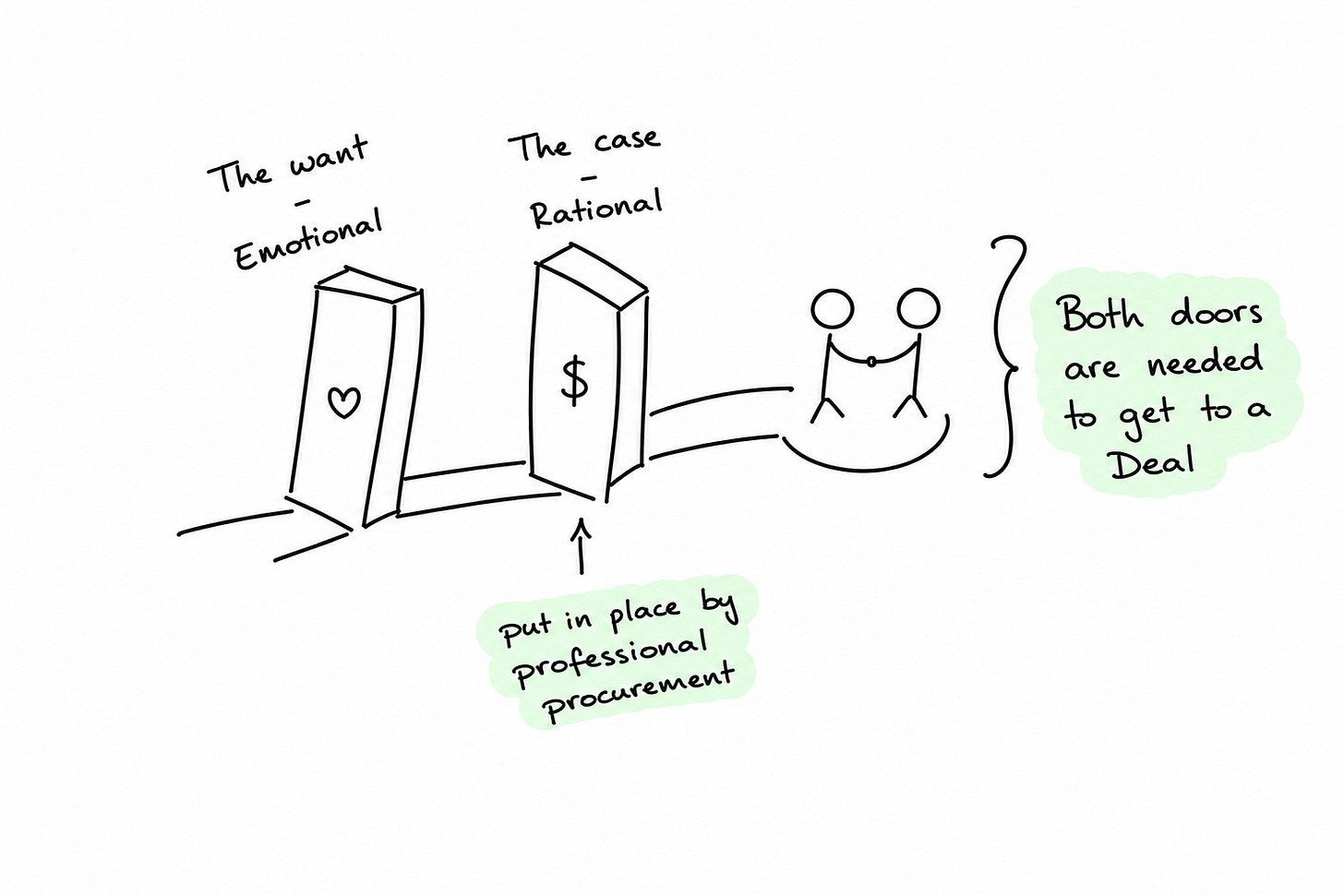
- Goodnotes drawing. Made readable by Chat. -
So, we are left with two doors:
Door one is the want.
The personal, emotional or career-shaped reasons your champion wants this to work. Bain’s catalogue of B2B value drivers names a few I see across my engagements: reduced anxiety, the story the champion gets to tell their board, prestige, the career upside if it works. Without this door open, you do not have a deal.
Door one is also a real craft. Building a story that makes a champion fall for your product and stay with it through three internal reviews takes work. A lot of marketing budget points at it. A lot of sales training points at it. A lot of books are written about it. Good. Door one matters.
Door two is the case.
What the champion can put on paper and bring into a conversation she is going to have, whether you are in the room with her or not. A buyer-specific TCO. A comparison to the actually-available alternative. The cost of doing nothing in the buyer’s own numbers. A risk-adjusted ROI. Forrester surveyed 747 technology buying decision makers in 2019 and 97% of them said they used a business case to justify their purchase. Their 2026 buyer research has procurement showing up as a decision-maker in 53% of B2B cycles, from day one.
Door two is the less visible kind of difficult. TCO models, alternatives maps, segment-specific value cases. The behavioural-economics writing of the last decade has handed a lot of sellers a permission slip to skip all of it and call that modern selling. It is not …
The funny thing is, that you could see the case as an emotional driver of its own. It gives the champion the confidence to push internally by having the numbers. The pride of being the person who brought a defensible case to the table. The fear of looking foolish in front of the team. When you build a strong door two, you are also building door one.
The Pricehiker’s Guide
Our weekly topic to hitchhike towards pricing excellence
Look at your last three lost deals. For each one, can you say which door was open, and where the other one closed?
If you cannot, how will you start tracking this?Would you sleep well if your champion had to defend your price to her CFO tomorrow morning?
A buyer-specific TCO? A named-alternative comparison? A risk-adjusted ROI in the buyer’s currency?Would you sleep well if you (yourself) had to defend your price to her CFO tomorrow morning?
From the lab
A real case. We changed enough to keep everyone comfortable.
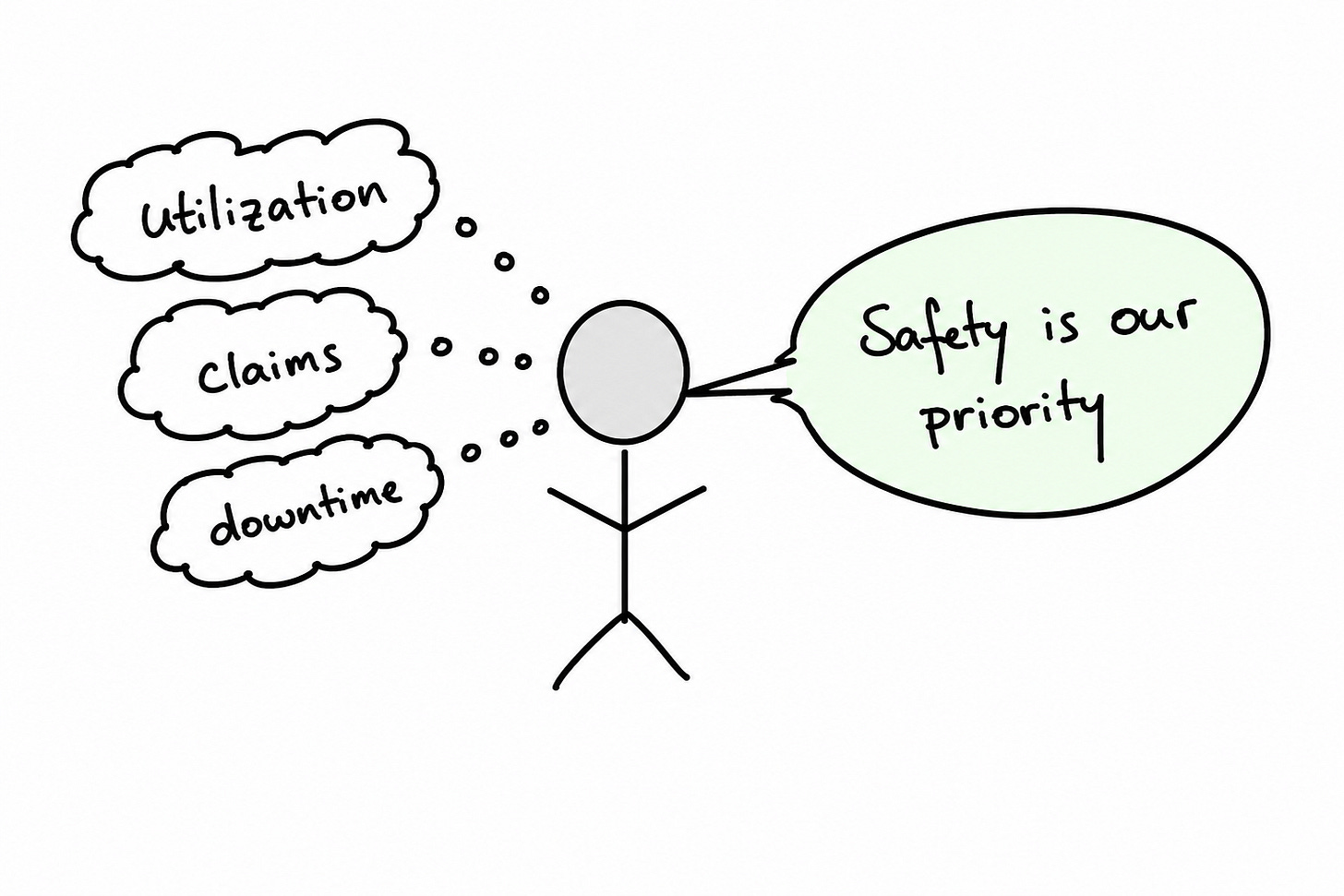
- Drawing, same as above -
A few years ago I worked with a company in heavy industry. They had built something that made one of their customers’ core operations significantly safer, the strategic priority for almost all big players.
The product really did not work well in the market…
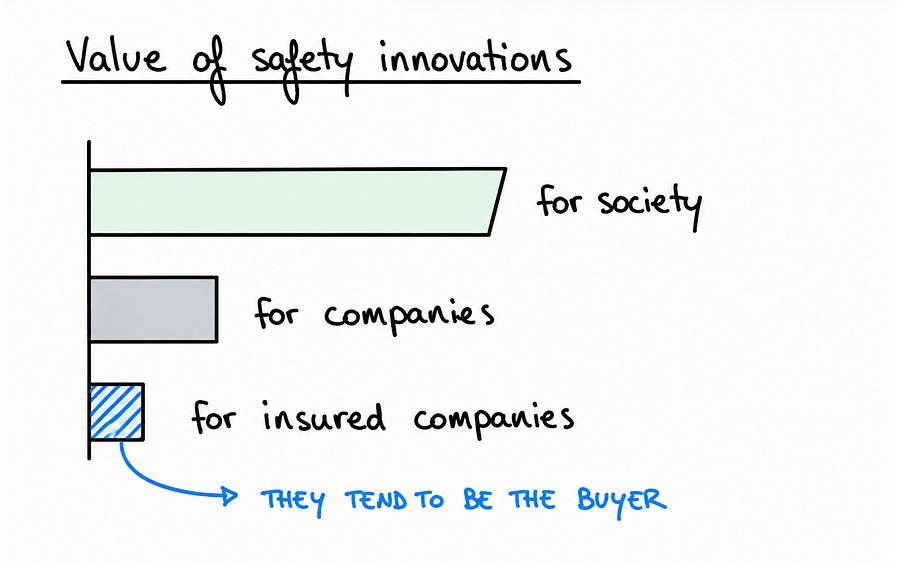
The champions on the buyer’s side were on board. The operators liked it. The technical buyers liked it. Procurement and finance, every time, came back with a version of: “we have insurance for that.” The buyer’s CFO did not own the cost of an incident. The insurer did. (a whole new post could follow from this tbh: how to price safety?)
The fix took a while, but we found something. We rebuilt around what the buyer’s financials did track: utilization (operational uptime). Compliance positioning ahead of a tightening regulation. With the same product & same emotional case, but a completely different rational case.
This by the way was also the main reason to change the ICP from a safety focused industry to a utilization focused industry (pricing can really drive the whole GTM it seems)
The lesson I want you to take from this post.
Door one is necessary
Door one is not sufficient
What’s next
A peek at what’s brewing. Unless you’ve got a better idea.
I am keeping an idea for blogposts list, and two things I wrote down this week
How to price safety properly.
The From the lab section touched it a bit. There are many strange twists and turns when you innovate on safety. (Everyone has it as a priority, but no one has budget)Recurring revenue trap for hardware.
Every hardware founder I talk to hears from their board that the company should move to a subscription or usage model. Sometimes that is the right call. Often it is holding them back.
Where we validated our truffles
If you don't trust me, three people who have done more homework.
Kahneman, D. (2011). Thinking, Fast and Slow. Dual-process theory. The specific finding the post leans on is that slow, deliberate thinking is enhanced when the decider is held accountable to others. That is the procurement gate in one sentence.
Almquist, E., Cleghorn, J., & Sherer, L. (2018). The B2B Elements of Value. Harvard Business Review, March-April 2018. On how subjective and objective value drivers stack inside a B2B decision. Worth citing because it is evidence that emotional drivers matter in B2B, and the same piece insists on the full pyramid including the rational base. https://hbr.org/2018/03/the-b2b-elements-of-value
Forrester (Davison, D., 2020). ROI Business Cases Help Differentiate During Economic Uncertainty; and The State Of Business Buying, 2026 (January 2026 release). Forrester surveyed 747 technology buying decision makers in 2019 and found 97% used a business case to justify their purchase. Their 2026 buyer research has procurement as a decision-maker in 53% of B2B cycles, engaging from the start. https://go.forrester.com/blogs/roi-business-cases-help-differentiate-during-economic-uncertainty/ and https://www.forrester.com/press-newsroom/forrester-2026-the-state-of-business-buying/
Max also publishes these notes on Substack. Subscribe there, or below, to get the next one in your inbox.