· 9 min read
One Product, One Price: Who Decided That?
What fences have to do with pricing.
 Max RymenCo-Founder · Pricing
Post 4 · Be · Beryllium
TLDR: Most B2B companies charge one price for a product that is worth very different things to different buyers. They tell themselves it’s the simple, fair, professional option. It’s also (especially for innovators) the fastest way of leaving most of the value on the table. Pricing has had a solution for this for forty years. Most companies still don’t use it.
- Goodnotes drawing. Made readable by Chat. -
A couple of years ago I was in a workshop with the coolest client I ever worked for. We were on a question that, by then, I had been hearing for 5 years. The product served two very different applications. In one of them it was a productivity bump. In the other, where downtime was measured in tens of thousands of euros an hour, it was the difference between a working line and a stopped one. Same machine, same operating system, very different value. (you probably recognize these situations if you read the previous posts: prerequisite for value-based pricing, launch pricing & focus)
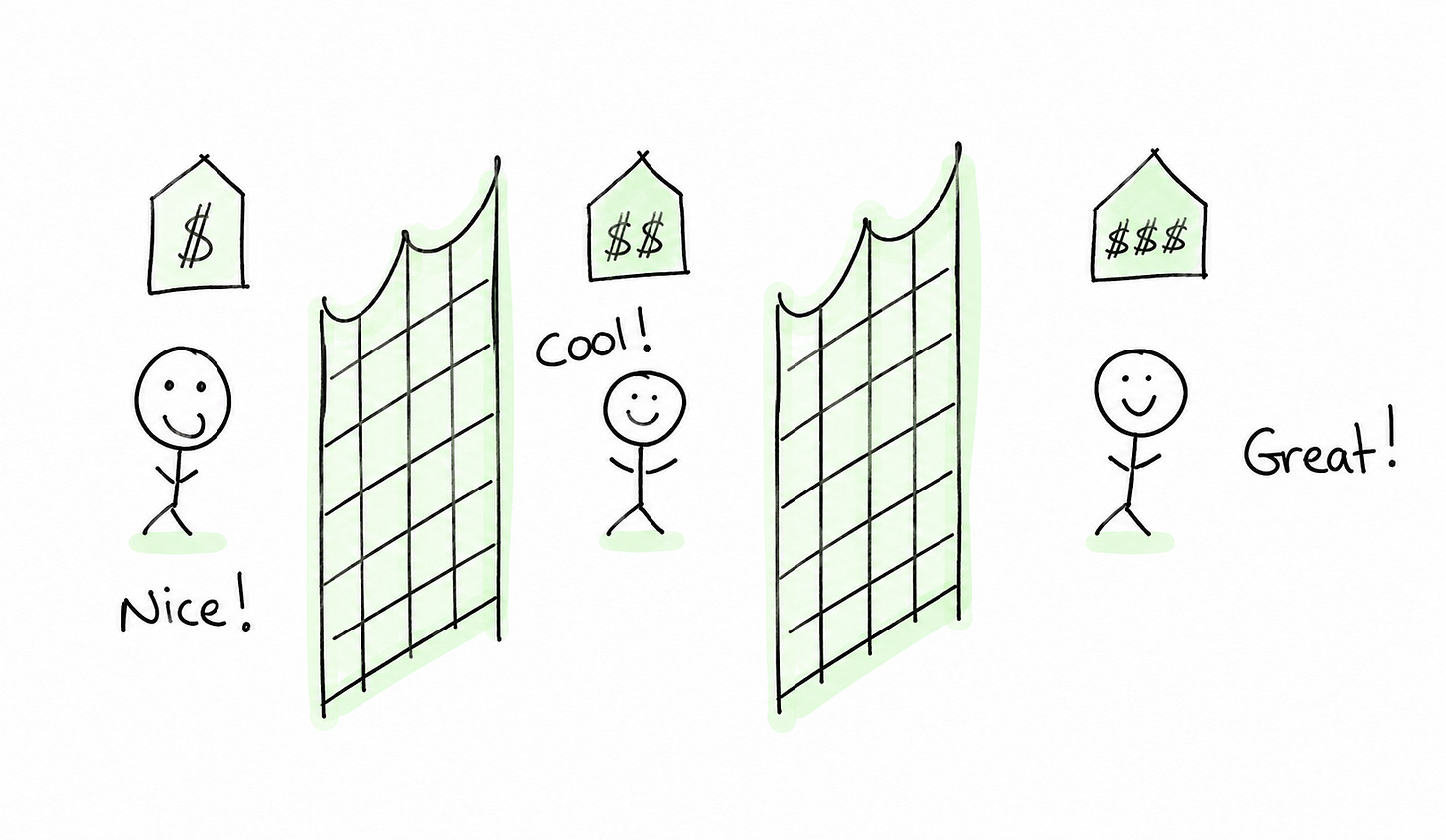
Someone in the room drew two prices on the whiteboard. Then she circled the gap between them and said: but how?
That gap is the question this post is about. The pricing world has a name for the answer. They call it a price fence.
A price fence is a mechanism that lets you match your price to the willingness to pay of different customer segments, without just putting a different number on the invoice. In B2C the fence is sometimes a wristband (student tickets at the cinema, senior fares on a train). In B2B it’s (I might have to say almost) never a wristband. It’s built into the product configuration, the contract, the service level, the channel, or the buying behavior. A structural reason for the different prices, that the different segments can each accept.
Worth saying up front: a price fence is not a trick on the higher-paying segment. The buyers on the more expensive side are paying more because they are getting more. If the only thing holding the fence up is that the high-paying segment hasn’t realised they could be paying less for something close, the fence is going to fail (your own alternative becomes the reference). You build a fence because your product is worth different amounts to different segments, and you don’t want to be forced to pick one. Without a fence, you choose: price for the high-value segment (and lose most of the market) or price for the average (and leave most of the value on the table). With a fence, both segments can be served at prices that work for them.
A strong personal opinion on which I like to debate with whoever is up for it (please let me know!): differential pricing is not a sales-team task. The standard line in the room is, “Pricing is not an issue for our sales team. They’ve been in the market for twenty years, they know what they’re doing.” Honestly, the people who do pricing well in my experience tend to be the ones who are two years into the job, not twenty. They are the ones who actually had to learn it on purpose. The twenty-year veteran is, more often than not, the source of the leak, because their instinct is to close the deal and protect the relationship, and those instincts are exactly the ones a fence has to push back against. (He or she might still be the best damn sales on the team - not arguing with that!!) But… sales-team discretion is the most common way companies “do” differential pricing today. It is also the most common way it stops working.
Now, the practical part. There is no single right fence. There is a spectrum. Which is nice, because it gives you options.
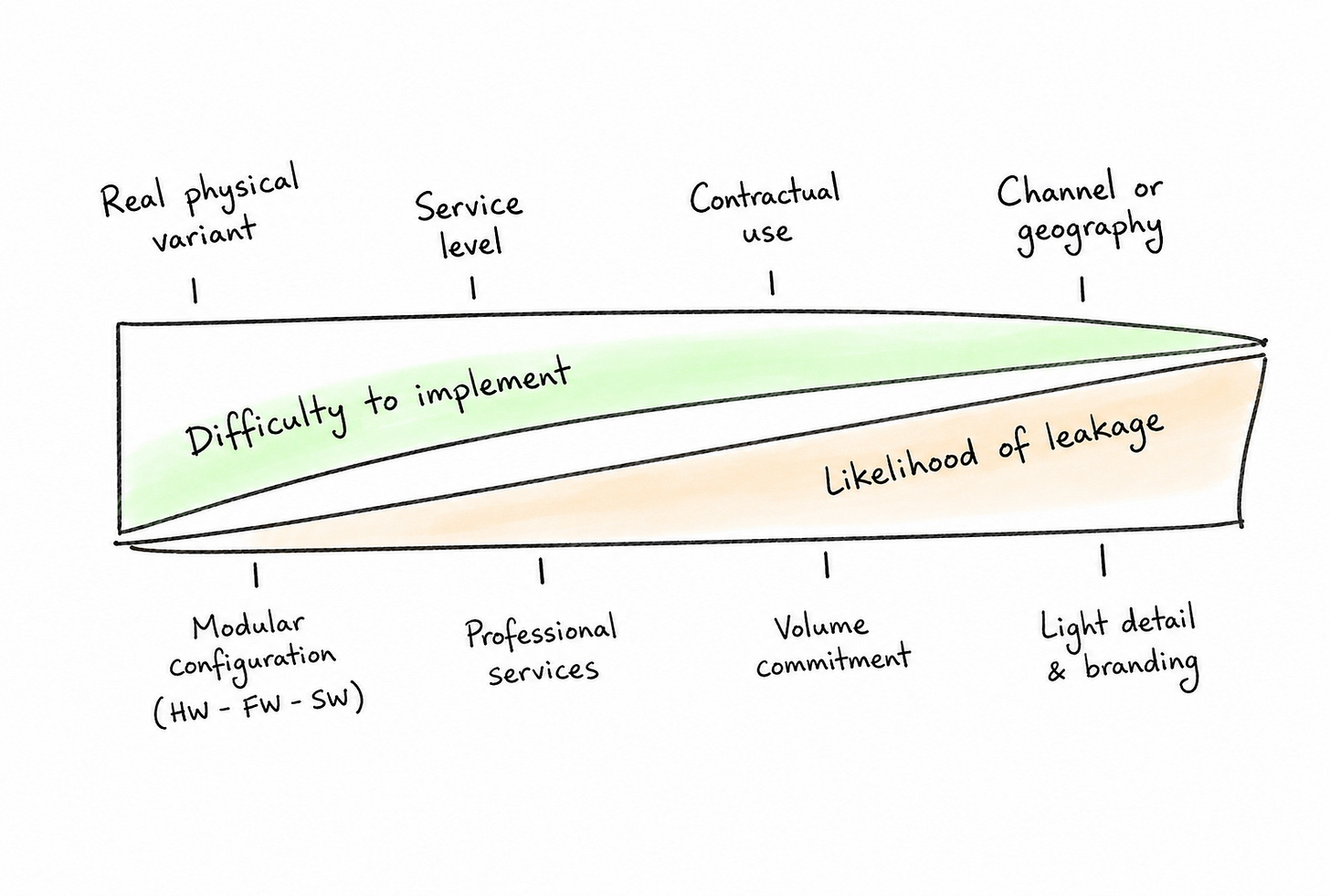
At one end is the heaviest fence: a separate product line under a separate brand, with separate sales motions. (Toyota & Lexus) Robust, almost impossible to leak, expensive to run. At the other end is the lightest: the same product with a slightly different label, sold at a different price to a different channel. Cheap to operate, more likely to leak when buyers become more sensitive.
In between are most of the options that matter, a short list below from robust fence to light detail:
A real physical variant of the same platform.
Different components, certifications, materials. The lubricant case I’ll get to in a moment lives here, and it is also a useful counter-example to the lazy rule that “lighter fences leak faster.” Some physical variants are very light to produce and very robust to defend.A modular configuration variant of the same product.
With an interesting question underneath: at which layer does the modularity sitHardware-modular (different physical configurations shipped to different segments) is operationally heavier but visibly different.
Firmware-modular (same hardware, firmware controls active capability) is lighter to manage and harder to bypass than software-only.
Software-modular (same hardware and firmware, software gates the feature) is the lightest to operate.
The strategic move that firmware- or software-modular fences unlock: ship the full capability into every unit (same hardware), sell only what the buyer needs today, unlock the rest later as they grow into it.
Tip for those in tender businesses: Useful for getting through tenders where the buyer is pushing on price by claiming they don’t need the advanced features. You stay in the deal at the lower configuration, and capture the rest of the value later as they activate it.A service-level tier (same product, different uptime guarantees, support, response times).
A bundle of professional services around a standard product (the bundle is the fence).
A contractual use restriction (same product, the contract limits the application or market it can be used in).
A volume or commitment fence (same product, different price by quantity or contract length). The problem here is that it often does not correlate with the value you bring - but it is likely the most used fence out there because big buyers tend to have professional procurement teams.
A channel or geography fence (same product, different price by route to market or region). Geography can work well if there is a supply chain reality that allows for that
A light detail or branding fence (same product, but slight different design to signal specifics in a market)
- drawing: same as above -
Three useful dimensions sit underneath all of these, and most real-world fences combine more than one:
Who they are. A characteristic of the buyer that’s checkable and stable. Industry, application, regulatory category, accreditation. The fence holds when the characteristic is hard to fake or change.
What they get. A real underlying difference in the offer. Configuration, certification, capability, integration depth, service level. The fence holds when the difference is real, not just labeled.
How they buy. Behavior that’s costly for the wrong-segment buyer to mimic. Volume, commitment length, channel, contractual restrictions on use. The fence holds when the behavior is hard to fake at the relevant scale.
A note on what’s actually new since the initial textbooks were written, because this matters for innovative companies. Modern instrumentation makes light fences much more robust than they used to be. Connected products report their own use back to the supplier. Server-side feature unlocks remove most of the historical fragility of firmware-locked tiers. Geofencing via GPS makes geography-based fences enforceable. Outcome-based pricing, where the buyer pays based on a measurable result rather than the unit, has become operationally feasible. The corner of the spectrum that has shifted most is the one where you want to be: light to operate, hard to argue with.
So… why is it that so many companies don’t have real fences in place yet?:
They confuse “we discount for segment X” with “we have a fence.”
They rely on sales-team discretion. I’ll still write about that, but you better make sure your incentive structure is ready for this.
The Pricehiker’s Guide · For anyone who read this far and has 10 minutes today that might trigger a new pricing strategy
Three questions. Run your own product through them, on whatever piece of paper is around.
Is my product really worth different amounts to different segments?
Be honest. The answer needs to be yes for the rest of the exercise to be useful. (If you’re not sure, this post might help.)What is the lowest cost fence I can introduce that ?
Look at the list above (potentially starting from the bottom) and work out some options.If two of my customers from different segments compared notes tomorrow, would they say “that makes sense”?
The strongest fences are the ones where the answer is “that makes sense” because there is a real, specific reason for the price difference. Configuration. Certification. Service level. A contractually restricted use. But of course, I am not going to claim that they will love paying more than others.
From the lab
A real case. As always, we changed enough to keep everyone comfortable.
A company that designs and builds modular industrial fencing systems. (Yes, I transformed it to a fence company. Because I could.) Their core product is a modular barrier system used across factories, warehouses, and other industrial facilities. The barriers have moving parts (gates, hinges, automated locks) that need lubricant.
Across most of their pipeline, the standard food- and industry-grade lubricant works fine. For the high-value segment, where the barrier sits inside cleanrooms or pharmaceutical facilities, the standard lubricant is not certified. The buyer can’t legally accept the product. So the engineering team identified a cleanroom-grade lubricant that worked across both environments and barely costs more to source. (you could wonder about their pricing… but let’s stick to our fences)
This turned out to become a strategic decision. Do you spec the cleanroom lubricant on every barrier (simpler supply chain, no higher unit cost across the board), or do you keep two specs and use the cleanroom-grade variant as a price-fence?
The case for one spec: less complexity in the factory, fewer mistakes, less inventory. Clear choice in a one price world.
The case for two specs: the cleanroom variant becomes a real, certifiable, defensible fence around the high-value segment. The buyer in the cleanroom segment is paying meaningfully more for the certified barrier. The certification matters to them and is checkable. The increment in production cost is small relative to the price difference. The business case on the high-value segment was somewhere around a few hundred times return on the lubricant uplift.
Neither segment is unhappy, because the cleanroom barrier is, in the precise sense that matters to the buyer, not the same product as the warehouse barrier. Using this product still brings great ROI to the cleanroom customers
The point of the case is the lightness of the fence. They didn’t need to build a full separate product line. They picked one component, applied a change, and turned it into the structural reason for a different price. Almost free to operate, very hard to argue with.
Another reason for everyone to understand the impact of pricing! (I might be biased)
What’s next
A peek at what’s brewing. Always open for ideas or struggles you are facing!
Two threads from here.
First: what segmentation actually serves pricing. The four buckets your organisation has been using everywhere for the past ten years (industry, company size, region, maybe customer maturity) almost certainly aren’t the right segments for pricing.
Second: outcome-based pricing, the S-grade of fences. The buyer pays on what they actually achieved with your product, not what they took home. The high-value segment self-selects in (their outcomes are bigger, so they pay more), the low-value segment self-selects out. The fence is structurally hard to break. The reason it isn’t more common is that doing it requires a specific set of conditions.
Where we validated our truffles
We see it in the field. They proved it in the papers. Funny how often those match.
Nagle, T., Müller, G., & Gruyaert, E. The Strategy and Tactics of Pricing (latest edition). Routledge. The textbook that codified price segmentation and fence design as a discipline. Still a must read for everyone!
Tellis, G. J. (1986). Beyond the many faces of price: An integration of pricing strategies. Journal of Marketing, 50(4), 146-160. The classic academic taxonomy. Older, the language is still in active use.
Hinterhuber, A., & Liozu, S. M. (Eds.). (2017). Innovation in Pricing: Contemporary Theories and Best Practices (2nd ed.). Routledge. Multiple chapters that take the older taxonomies forward into modern fence design.
Max also publishes these notes on Substack. Subscribe there, or below, to get the next one in your inbox.