· 7 min read
How the Cheapest Price You Ever Charge Can Become the Most Expensive Decision You Make
Your launch price is a promise you will likely have to keep
 Max RymenCo-Founder · Pricing
Post 2 · He · Helium
TLDR:
Innovators tend to (or love?) this plan: price low, prove value, increase later. The inconvenient part: “increase later” part almost never happens.
It comes down to this: your launch price doesn’t stay between you and your first buyer. It spreads to procurement systems, competitor pricing, investor expectations, and your own sales targets. By the time the product proves its value, the number has hardened. There is good news, you can do something about it!
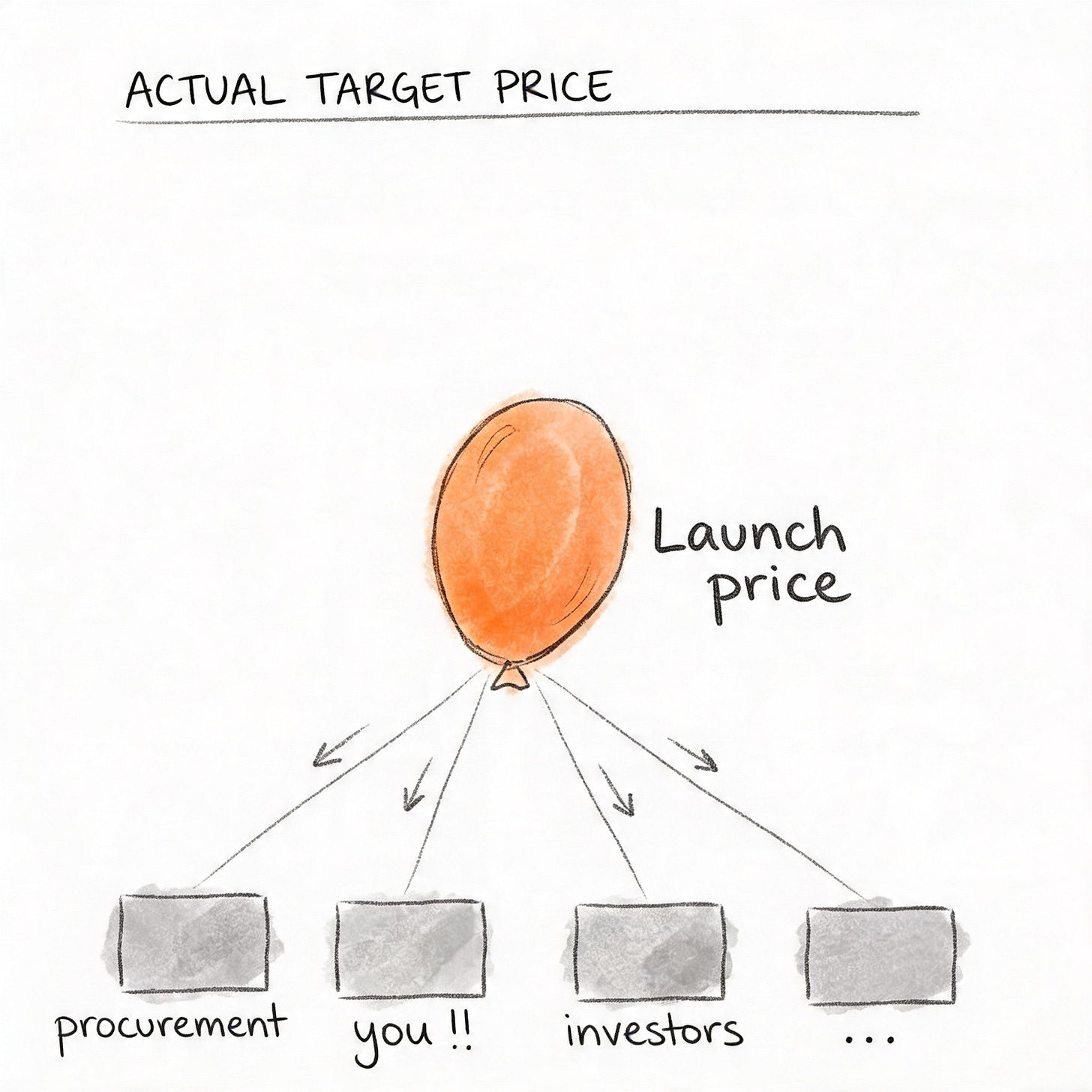
- Worked a balloon in the drawing (He): made on my Goodnotes and made readable by Nano Banana -
“Right now we just need to prove we can get 10 units in the market.”
I hear some version of this constantly, from robotics founders, from deeptech teams, from anyone building or launching a new innovative product. The logic is sound and often taken from well-know consumer examples: reduce friction, get the product into real environments, learn from actual usage. Price low now, increase to the actual level later once you’ve proven the value.
I used to nod along with this. It sounded responsible. Start small, learn, then scale the price with the value. Until I watched it play out across start- & scale-ups and even large enterprises (At least they probably knew better …).
There’s a name for this, by the way. Joel Dean coined it in 1950 (!! think about the innovations that have been priced since the 50’s): penetration pricing. Set the price low to build volume and market share fast. The alternative is skimming: start high, capture the buyers who value it most, then lower the price as the market matures and competition enters. (and there is actual price sensitivity) Both are legitimate strategies. The problem isn’t choosing penetration. The problem is choosing it by accident, without thinking about what comes after.
Penetration pricing works when you have a plan for what "later" looks like. When you know at what volume or milestone the price goes up. When your contracts say so. When your buyers expect it. And ideally before competitors enter, because once they do, they price against your number and your window to raise becomes smaller.
I have honestly not seen a lot of “increase later” and it is not because the value isn’t proven (it usually is, eventually). But because by the time you’re ready to raise, the price has embedded itself in places you didn’t anticipate.
Your buyer’s procurement team has your old price in their system. It’s the line item they approved. Any change triggers a new approval process, new conversations, new justifications.
Your own sales team has been selling at the old number. Their targets, their pipeline, their commission structure, all built around it. Telling them to go back to the same (or worse, new…) customers with a higher price while their quota stays the same is … not a conversation anyone volunteers for.
Your investors are tracking volume. They want to see units shipped, adoption curves going up. Raising the price risks slowing that curve, even temporarily, and that’s a hard sell in a board meeting where the story has been “look at the traction.”
And then there’s the market. If you priced low enough so you competitor felt like they had to follow you, congratulations: you’ve started a price war you didn’t intend to start. Your launch price is the reference point for alternatives you now have to compete against.
A review from an innovation on Reddit captured the buyer side perfectly: “The quality is still great. I even considered upgrading… But I can’t justify paying double for less work than I was getting before. That felt genuinely unfair.”
(I noted the quote when I read it but unfortunately not who wrote it - if you are that person, please let me know so I can add your name here)
That last word is the problem. Not “expensive.” Unfair.
The Pricehiker’s Guide · A recurring section since I got positive DM’s. For anyone who read this far and actually wants to do something about it.
If you’re setting a price for a new product (or an existing one entering a new segment or region), start here:
Do you actually need low prices to make this work?
Penetration pricing might make sense when volume drives your economics: manufacturing scale that lowers unit cost, network effects where more users means more value, or a market where switching costs will lock customers in once they adopt. If none of those apply, you’re not doing penetration pricing. You’re likely just afraid to price what you are worth. (sorry, small mirror)Do different buyers get very different value from the same product?
If yes, one price is likely the wrong answer. The robotics example later in this post is a case in point: same platform, 10x difference in value across applications. Skimming (starting with the highest-value buyers) or segmented pricing gives you room.If you go low, can you write the exit into the deal?
Real penetration pricing has a plan. Pilot pricing for 6 months, with the commercial rate stated in the contract. Early-adopter discount that expires on a date. Volume commitment tied to a price tier. If there’s no mechanism in the deal that moves the price back up. Force yourself to show the actual target price.
One rule regardless of which path you pick: show the real price. If you want to lower the barrier, use a discount on the actual number, not a different number. Your buyer sees what the product actually costs from day one. When the discount ends, the price isn’t going up. It’s returning to what it always was.
From the lab
A real case. We changed enough to keep everyone comfortable.
A robotics company building something new: a platform adaptable enough to serve different applications across industries. They were creating a category of robots after years of research. At the moment of launch, there was no direct competitor, established price point, or benchmark for buyers to compare against.
A few years later, when we got involved, pricing had never been a real conversation. As it often goes at innovative companies, conversation for multiple years had been about technology readiness, manufacturing scale, and getting units into the field. Fair enough. But the consequence was that the pilot price became the number. The number became the list price in an Excel file. And then (… it hurts to write it) even new versions got priced as a percentage increase or decrease compared to that original back-of-the-envelope figure.
This is a platform that could be worth radically different amounts depending on the application. In one use case, it replaced a process costing the customer a few 1.000 euros per year (1.180 USD, for who is keeping track). In another, the savings were 10x larger. Same hardware. Same software. Completely different value.
But every commercial conversation started from the same anchor: the first pilot price they ever set. Even the high-value applications got pulled back to that number.
This is where a skimming approach would have changed everything. Instead of pricing for the broadest possible adoption, you might be able to start with the buyers who get the most value. The ones willing to pay a price that reflects what the platform actually does for them. You build your reference price around real value, not around what felt safe for the first pilot. Then, as the market matures and competition enters (which to be fair - might happen faster when skimming), you work your way into the lower-value segments at prices that still make sense.
And to serve both at the same time? That’s where price fences come in: tweaks that allow you to manage different prices for different applications. More on that in a future post.
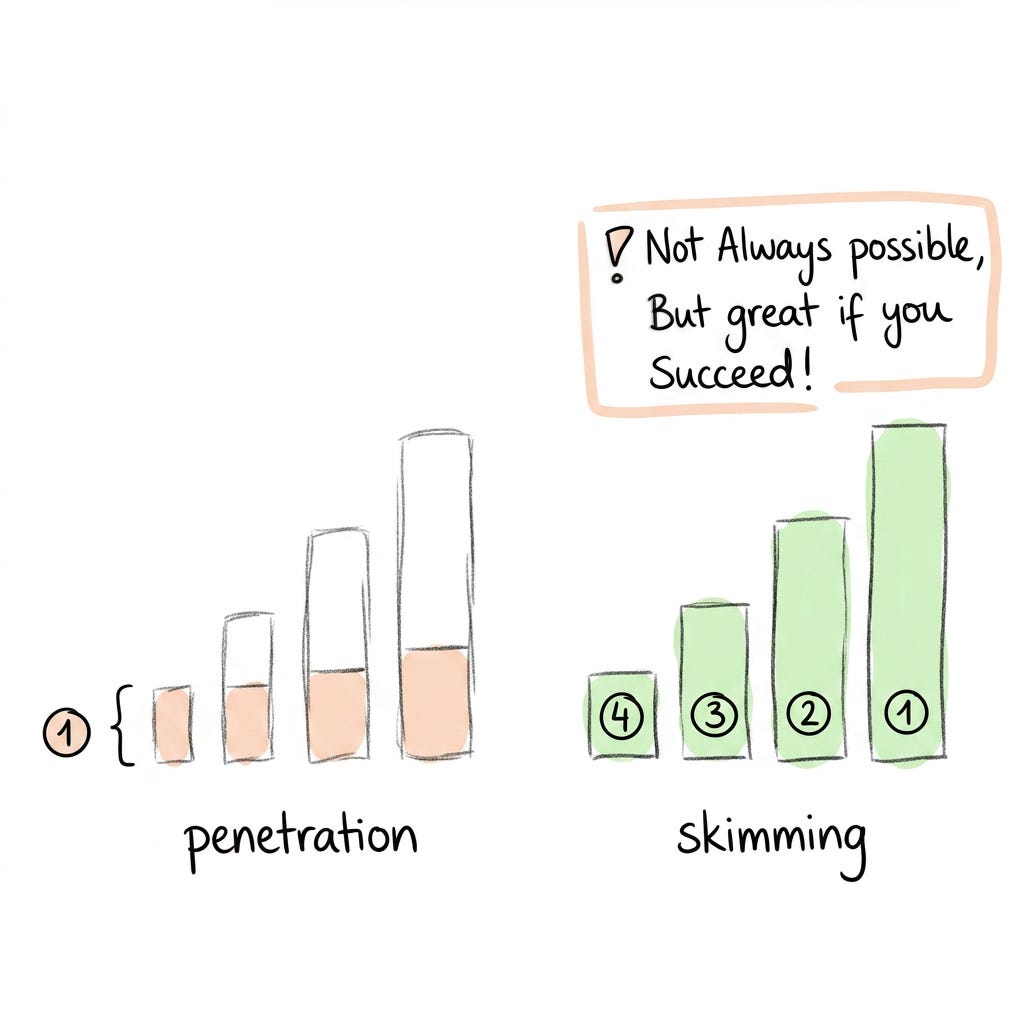
- drawing: same as above -
What’s next
A peek at what’s brewing. Unless you’ve got a better idea.
Two threads from here.
First: if different applications of a similar product have wildly different value, how do you charge different prices? That’s price fences, and building them well is its own discipline.
Second: your marketing segments and your pricing segments probably shouldn’t be the same thing. The neat customer buckets that work for your go-to-market deck might be hiding the real differences in willingness to pay.
Where we validated our truffles
We see it in the field. They proved it in the papers (or books in this case). Funny how often those match.
Dean, J. (1976). Pricing Policies for New Products. Harvard Business Review, 54(6), 141-153. (Originally published 1950. see text) The original skimming vs. penetration framework. Dean argued that penetration pricing makes sense when you expect competition and need share fast. What gets missed: he also warned that the low price sets the market’s expectation, making it nearly impossible to raise later. Written in 1950 and still the most relevant sentence in most pricing conversations.
Ramanujam, M. & Tacke, G. (2016). Monetizing Innovation: How Smart Companies Design the Product Around the Price. Wiley. Found that 72% of innovations fail to meet their financial targets or fail entirely, largely because pricing comes after the product is built instead of before. Their core argument: have the willingness-to-pay conversation before you ship, not after. Directly relevant to the “figure it out later” instinct. We mainly focus on 1 of the 4 challenges he talks about: Minivation. (product is right, market is right, price is too low)
Max also publishes these notes on Substack. Subscribe there, or below, to get the next one in your inbox.