· 7 min read
Can Your Pricing Keep Defending Itself?
Why B2B is moving to continuous pricing.
 Max RymenCo-Founder · Pricing
Post 5 · B · Boron
TLDR: If a prospect asks why your price is what it is, can you answer? The proper kind of answer, with specifics about value, about how you compare, about what he or she is actually getting. Continuous pricing is the practice of keeping that (and many more) answers alive: what your competitors are doing, what value you deliver, how your packaging holds up, how the price flows through different regions and markets. The question is whether you are practicing it yet.
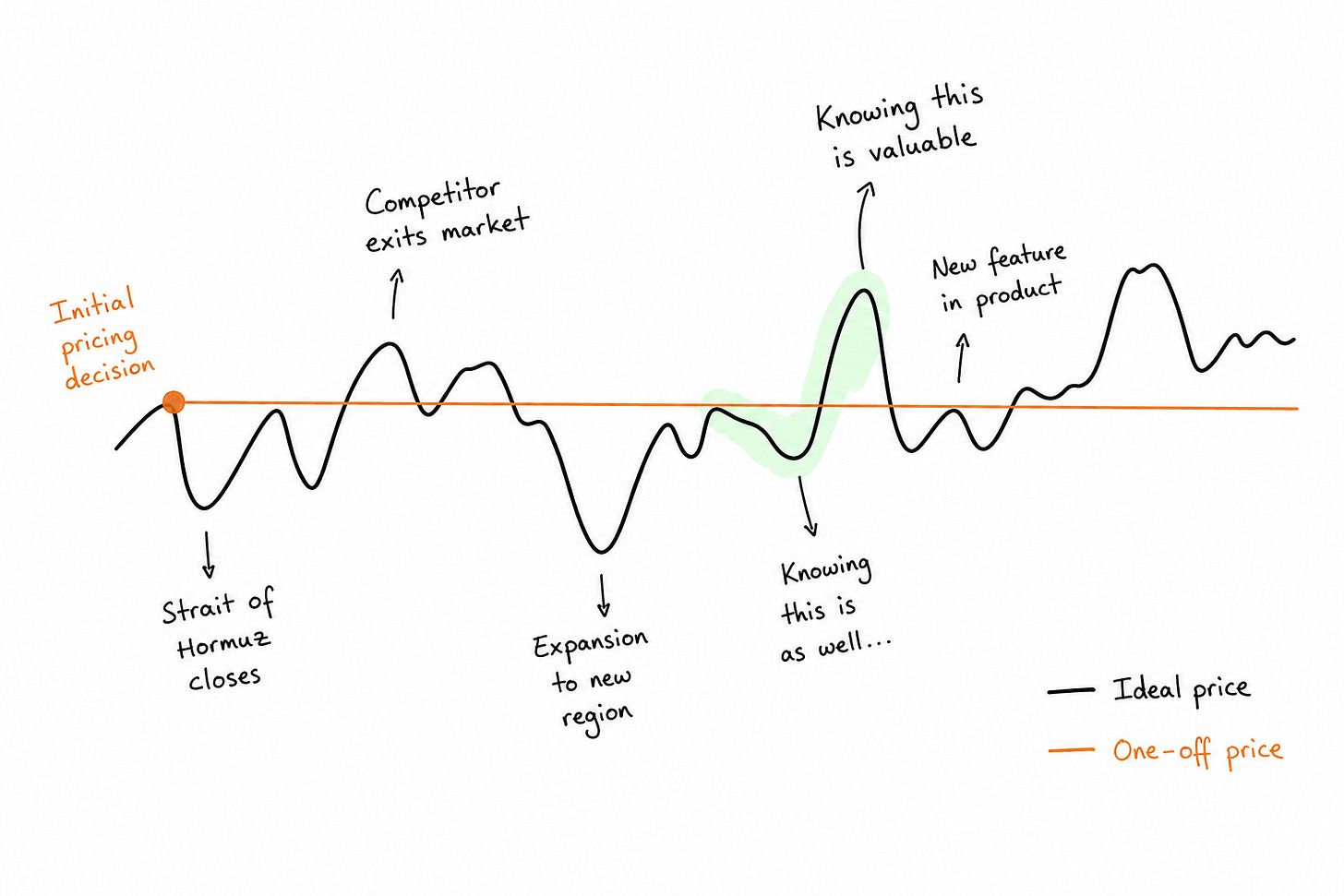
- Drawing made on Goodnotes. Made readable by Chat. -
With companies that are reactive (if not static), I often get these:
“Our pricing is good. We have an A, B, and C segment, and we know what each one pays.”
“We do pricing based on the market. We asked customers for their willingness to pay.”
“We tried a price, the first customer said yes, that has been the price ever since.”
Three different ways of burying your head in the sand . The first says we already know. The second says we asked, and the buyer (politely) gave us a number that was lower than they would actually have paid. The third says we never decided in the first place. (at least it is very honest) None of them puts you in a position to make use of the power of pricing.
For the ones that did see that power, nicely designed tools and systems have existed to make sure that the organization sticks to the prices that were set. They go through a (hopefully not too painful) implementation and fill in the numbers from a one-off expensive pricing strategy exercise. Two weeks later a competitor enters the market, they go to a new region or the strait of Hormuz closes & the tool is making sure that they are very good at managing the wrong prices.
Now, look at the work your company already does continuously. Demand forecasts. Cost models. Procurement assessments. Internal reporting. Product analytics. Each of these used to be a project. A specialist somewhere ran it once a year, on a corporate budget, and the rest of the year you went on what they produced. Then the tooling got better and cheaper. Where did we see that before?
Excel made modelling something you do on the go
PowerPoint made decks something you make at your desk instead of a printshop
Modern BI made dashboards something a product manager runs without help
You know all the examples
The reason this worked is that the people realized something: being able to do this fast and often was what made it so valuable, not just saving some bucks in the printshop. A demand forecast you refresh every week is worth much more than one you refresh once a year, because by the time the annual version is finished, the assumptions underneath it have moved. New technologies are enabling a whole new set of these activities. Let’s look at what that means for pricing.
The first way to think about it is: what do we need to know at all times?
A) The value you deliver and how you talk about it.
Substance plus articulation. The same conversation, even if different teams own different parts of it. If you cannot say why your product is worth what you charge, in specifics, the price will not survive the next prospect.
B) How you monetize and which price models you use.
Per seat. Per outcome. Per usage. Per unit. The model isn’t a one-time decision. Sometimes the right answer is to run more than one model at the same time, for different segments. Historically that was operationally too painful to consider. The tooling has caught up. Continuous pricing makes it normal to evolve the model, run a variant on a slice of customers, or use two models in parallel.
C) What competitors are doing and how you compare to them.
Their pricing, their packaging, their positioning. And preferably not the version where you have asked 3 customers in a survey... If they reprice, launch a new feature or product, you want to know immediately and understand what impact it has.
D) How pricing informs every other function.
(look at the lab section for what it means for your function)
R&D weighing whether a feature is worth the price premium it would enable. Product asking which packaging move would shift willingness to pay. Leadership preparing to talk to investors and strategic partners about a story that, in the end, is a price story.
There is this really famous quote from Warren Buffett that often pops up in pricing books. If You Need A ‘Prayer’ To Raise Prices, It’s A Terrible Business, and… who am I to argue with the OG himself. But a big part in this was always to know at any moment, where you can raise or should lower prices and by how much. Pricing power isn’t binary, on or off. Many B2B companies don’t have that read at all and there is no reason not to.
The Pricehiker’s Guide · For anyone who read this far and has 10 minutes today that might trigger a new way of working
Three questions.
Could you defend your pricing to a sharp prospect today, with specifics? Specifics about value, about how you compare, about what he or she is actually getting. Not “we benchmarked.” or “this is the market price…” preferably with recent arguments like: this happened last week & you should care because …”
When was the last time your prices changed because of something specific that happened in the market this year?
A competitor move, a buyer cohort shift, a cost input change, a packaging experiment.Who in your organisation has pricing accountability in their day or week?
Based on your type of business and the people in your team: who should?
“Pricing should be a heartbeat. In too many companies, it’s still a heart attack every two years.”
From the lab
A real case. We changed enough to keep everyone comfortable.
A B2B industrial product company we worked with. Three product lines, two regions, low-thousands of customers. We ran a pricing project for a year, to make sure everything stayed live across the company. When we did our regular check ins later, this is what we used to hear across functions. At least in pre-AI times, I think this was the most impressive set-up I have seen.
A typical week:
The pricing manager (with her team to be fair) runs the weekly review. Reads the inputs on competitor moves, deal data, cost shifts, win rooms, customer signals from the field. At all times she knows & distributes the insights on: what is our value, how do we compare to alternatives & how should we translate that into prices.
The R&D team is at a stage-gate. Engineering is weighing whether a new module is worth its BOM cost. A year ago the answer would have come from a margin analysis. This time it comes from a brainstorm with the pricing manager: here is what this module would do to willingness to pay across the three segments, here is the trade-off, here is the band of prices it would let you defend.
The product team is restructuring application tiers. A new use case has shown up in the last quarter and the current packaging doesn’t capture it. Cohort behaviour, competitor moves, deal data, all on one page. Product gets a defensible answer on whether the new use case sits in the top tier, the mid-tier, or a tier of its own.
The commercial team is heading into a deal. The buyer is going to push on price. The account manager walks in with the current view of the segment, what comparable deals have closed at, and a clear articulation of value. The defence rests on evidence.
The finance team picks up a 0.3-point margin slip in one product line. Last year that would have surfaced at year-end and triggered a project. Now the pricing manager traces it inside two weeks to a cost pass-through that was agreed upon in the contract.
Leadership is preparing for an investor conversation. The story they tell is a price story (revenue, margin, pricing power, segment progression). The CEO walks in with this week’s numbers and a clear answer to the question every sharp investor asks: where are you updating prices, by how much & why?
In month five, a competitor entered with an aggressive launch price. The pricing manager read it inside a week, the six functions had their inputs by week two, the company responded on purpose. This was an early bet on continuous pricing that worked out. Now imagine we can manage all of this within one system… more on that later.
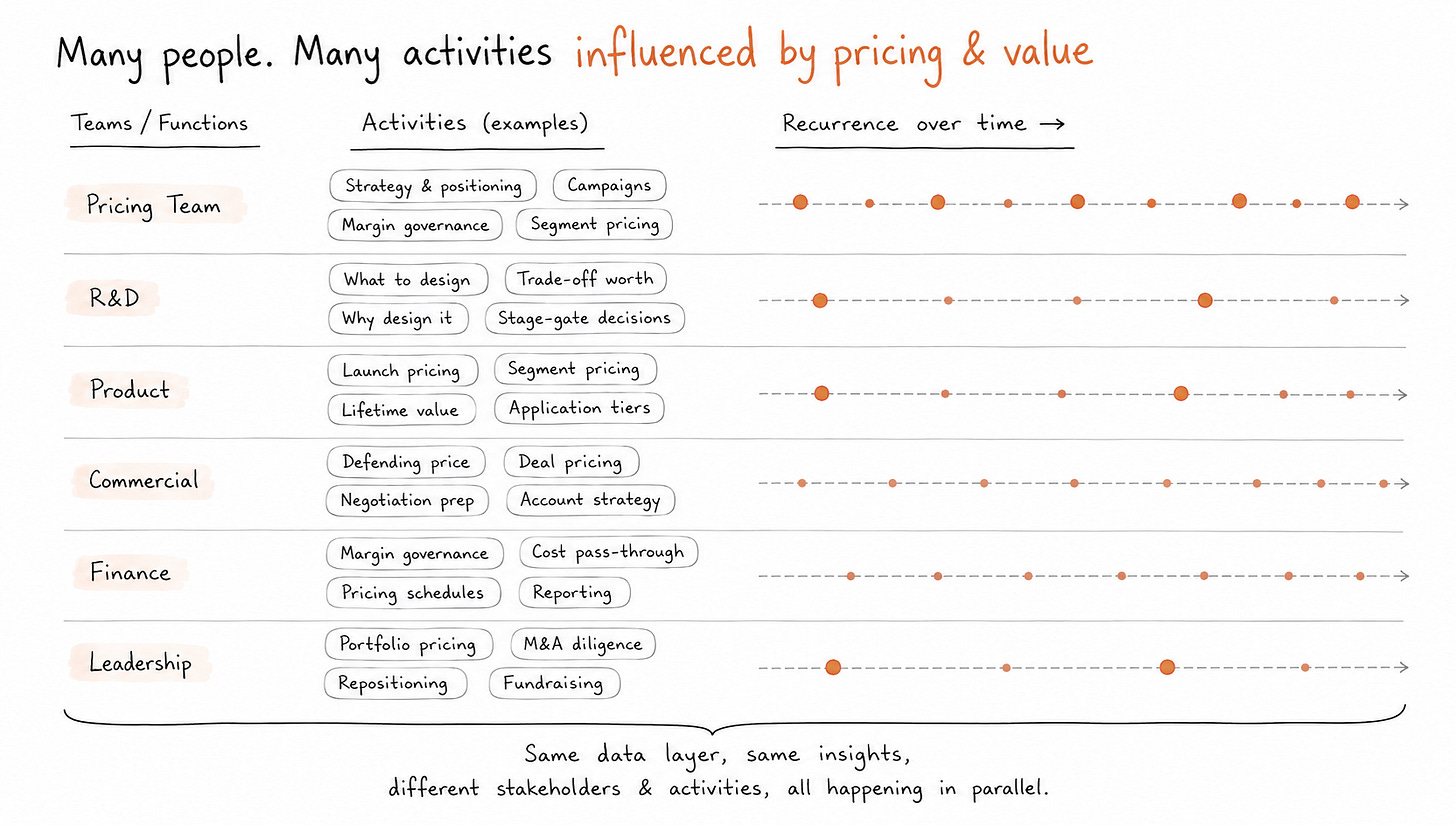
- drawing: same as above -
What’s next
A peek at what’s brewing. Always open for ideas or struggles you are facing!
Two threads from here.
First, outcome-based pricing. Owed from Post 4, where I called it the S-grade of pricing. The buyer pays on what they achieved with your product, not what they took home. Not made for everyone though…
Second, segmentation for pricing. A post I almost wrote in this slot and parked because I got some questions on continuous pricing.
Where we validated our truffles
We see it in the field. They proved it in the papers. Funny how often those match.
Phillips, R. L. (2021). Pricing and Revenue Optimization. Stanford Business Books. On treating pricing as a managed function rather than a project.
Buffett, W. Berkshire Hathaway.
The full quote: "The single most important decision in evaluating a business is pricing power," he said. "If you've got the power to raise prices without losing business to a competitor, you've got a very good business. And if you have to have a prayer session before raising the price by 10%, then you've got a terrible business."
Max also publishes these notes on Substack. Subscribe there, or below, to get the next one in your inbox.