· 7 min read
Being Odd Pays Off More Than You Think
And even then, you'll probably be lucky to capture half of what it's worth.
 Max RymenCo-Founder · Pricing
Post 3 · Li · Lithium
TLDR:
Most pricing exercises spread effort evenly across eight or nine features. But (in the best case) only two or three of yours are actually different from what the alternatives offer. And one of those, found in the right segment, can multiply what you can get for your solution (literally, sometimes by ten). Even then, what you actually capture comes down to how protected your differentiation is and how much you decide to leave with the buyer. Two questions you should urgently look at if you are a bit odd...
- Made on my Goodnotes and made readable by Nano Banana (still not the new OpenAI model) -
At the end of Post 1 I left a thread hanging. The post argued that pricing on value only really works if you’re actually different from your buyer’s next-best alternative. In the past couple of years I have been asked some version of the natural follow-up a few times. “Okay, but why is differentiation so valuable in the first place? Should we not just price a couple % away from the alternative?” I never properly took the time to articulate the answer. I’m doing it now.
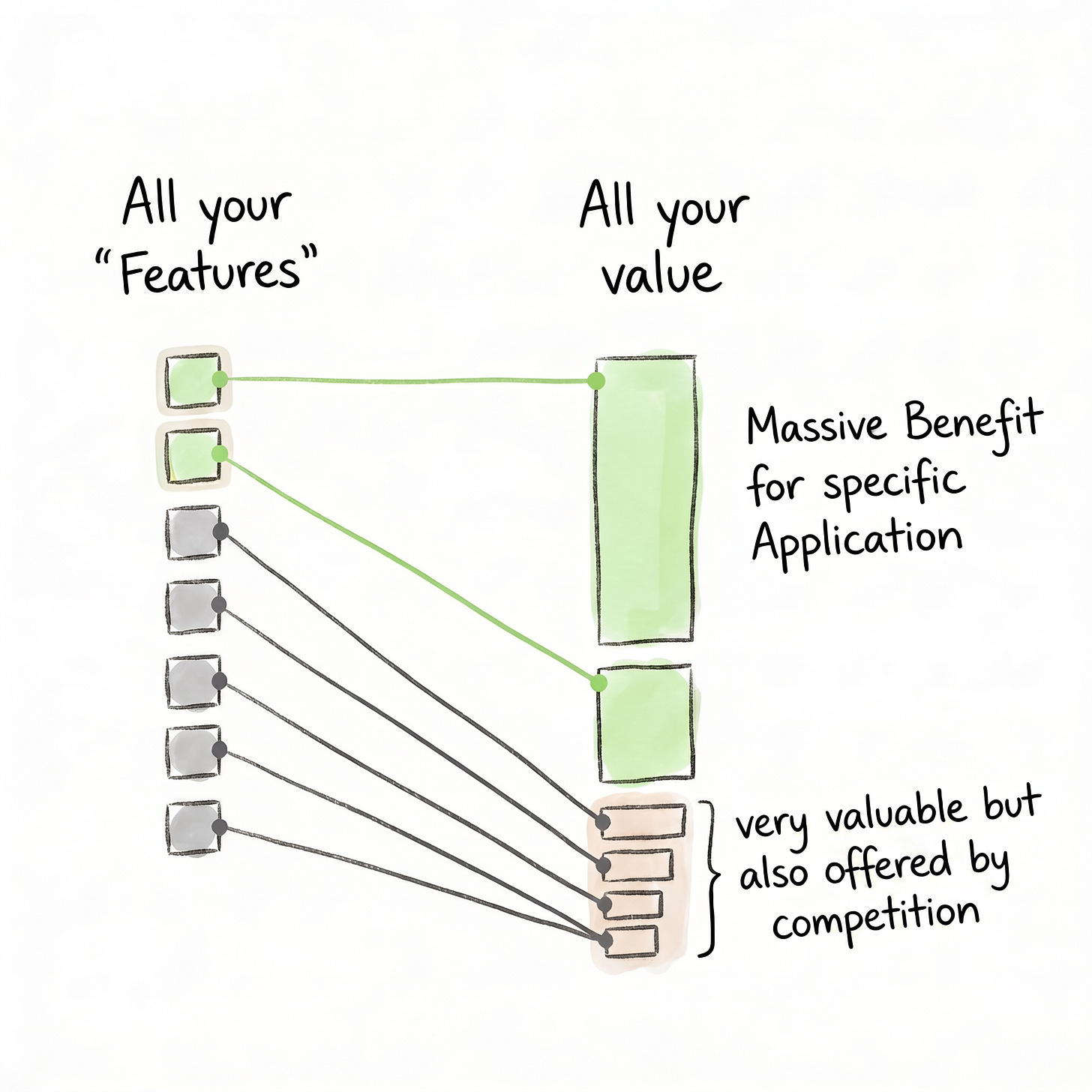
Most pricing conversations follow the same script. A team sits down with a product. They list features. (Features, by the way, are usually misdescribed. That is a different post.) They translate the features into value drivers, sometimes with an economic formula behind each one. They end up with eight or nine things that all look important on the page. And then they spread their attention more or less equally across all eight or nine.
Of those, typically only two or three are real differentiators against the buyer’s alternatives. The rest is shared. Even where you can argue a “different shade” of differentiation (a slightly better version of a thing competitors also do), the competitor usually has some shade of that too. The similar parts will get pulled toward whatever the next-best alternative charges eventually.
The two or three things you do that are actually different, where…
… competitors don’t really have a comparable answer
… the difference is hard to copy
… you might even have a patent on something specific …
… are the part of your offer where pricing has real room to move. So the job is to find the two or three that actually set you apart, and then go deep on them. Why is each one valuable? For whom? For which specific segment? At which specific moment? And does the buyer recognise that, today, in their own words?
A nuance worth being explicit about, because I have watched it cause confusion. Understanding the value of your full product across customer segments still matters, a lot. It tells you which customers to chase, how to talk to them, what to lead with in a sales conversation. That work is value-selling, and you can’t sell well without it. In a value-selling conversation you explain why the buyer needs this type of solution, leaning on how the whole offer compares against alternatives. Pricing is doing different work. Pricing leverage lives in the small set of things you are actually different on. The two activities overlap.
My main claim, and I hope the slightly black & white example below makes that clear: One value driver, found in the right segment, can outperform every pricing model optimization your team builds for the rest of your offer combined. Against the wrong reference point your differentiator is worth a 10% premium. Against the right reference point, in the right segment, at the right moment, it’s worth ten times the price. The difficult part is that you need to balance a lot of elements about who that buyer is, what they’re really comparing you to, and how much surplus you’re daring to take.
The Pricehiker’s Guide · For anyone who read this far and has 10 minutes today that might trigger a new pricing strategy
Three questions to answer on whatever piece of paper around you:
Of the eight or nine things you think you’re great at, which one or two are actually different from the alternatives?
Be honest. “We do X better” rarely passes. Patented elements, hard-to-replicate operational know-how, deep integration, regulatory access, scale that took years to build: those pass the test.For each one that passes, which segment values it most, and by how much?
This is where the big multiplication comes in. You’re not looking for the average buyer. You’re looking for the buyer where the differentiator turns “interesting” into “we can’t do this without you.”How much of that multiplier can (or do you want to) actually capture?
Your share is, broadly, a function of the buyer’s alternatives, your added value above and how well protected your differentiator is. Some actual research on this (Gans & Ryall 2017, linked below) is quite clear: outside options are dominant factors. In theory, capture rates of 30-70% are typical, in practice I do not see enough people with the guts to take it.
Want to first see an example before applying your case? Let’s go to the lab…
From the lab
Because an example from a totally different company typically is just what you need
A bit more of a fictional example this week - it is definitely based on elements that I have been seeing the past years - but I believe it makes most sense in this structure. And… since it is post 3 on Lithium, I wanted batteries…
Let’s say you sell a machine that operates in a harsh environment (I know these are some of the readers). Pick your poison: chemical plant, offshore rig, semiconductor fab, freezer warehouse. The dynamic works in all of them.
The machine runs on batteries. Your competitors’ batteries are perfectly fine, around €50 a unit and lifetime per battery is about the same. Your batteries do something the competitors’ don’t, however. They are integrated in set-up where they swap and charge themselves. Same machine, same operation, only the batteries change. So twice a shift, no one has to put on a hazmat suit and walk into the harsh zone to swap a battery.
For the buyer who runs that machine in that environment, the value of the swap-and-charge feature is not “€50, plus a bit.” It’s around €1,000 a day, the cost of not sending two people in hazmat suits into the harsh zone twice a shift, plus the avoided downtime, plus the safety risk you now don’t run. Across the lifetime of the equipment, much more.
The order of magnitude is the whole point. The competitor’s battery sells for €50. The value of your one differentiated feature, for the right buyer, is €1,000 a day. We are no longer talking about a 10% premium. Unfortunately, almost all companies I have worked with have the reflex here to say: wow really nice, we can improve our margins a bit… There is literally room to ask 20 times what the competitor charges (& that’s per day!), and it still be the obvious deal for that buyer.
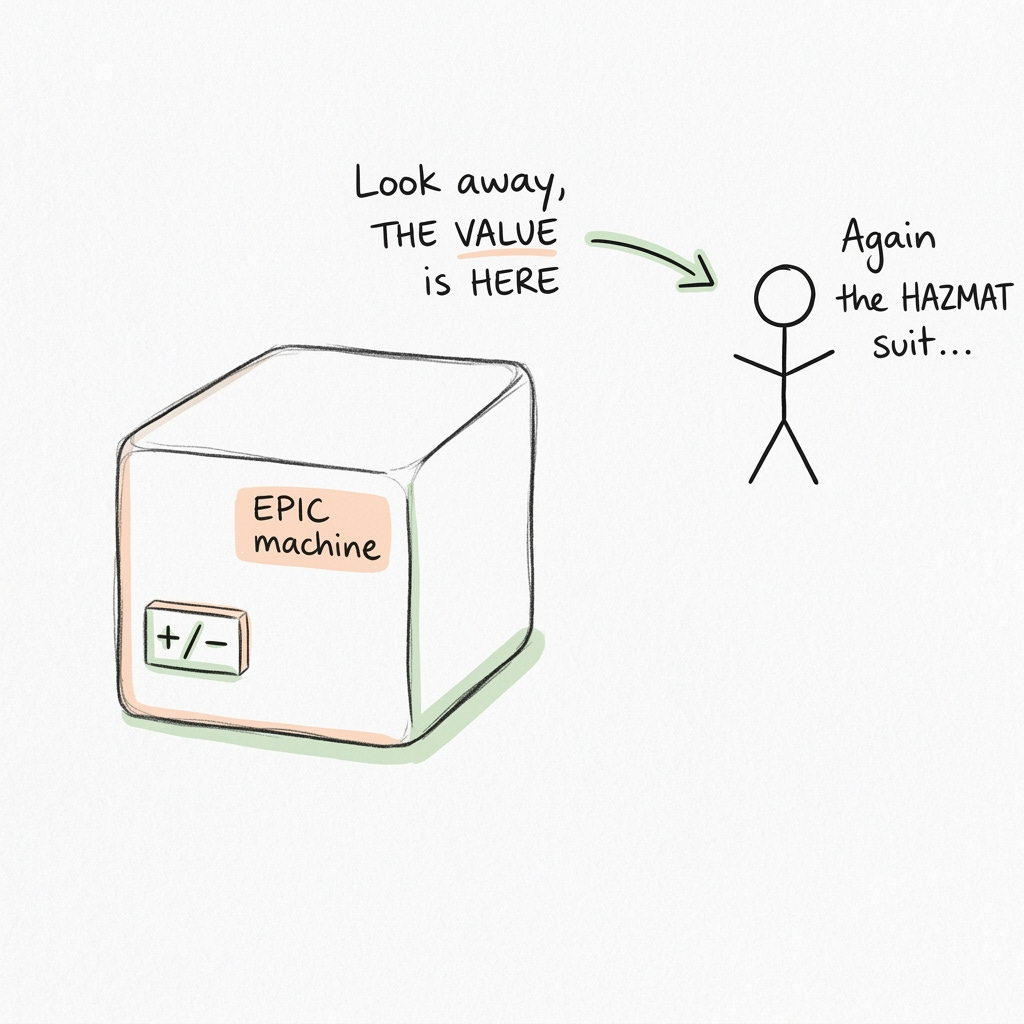
- drawing: same as above -
That brings us to that second part: How much of that €1,000 a day can you actually capture? Not all of it. Probably not even half of it, if I’m being honest. Pricing is partly a negotiation about how you split the consumer surplus, and a buyer who feels they took home no value isn’t a buyer you keep. The companies that capture closer to half rather than a third are usually the ones who treat the question seriously: how protected is the differentiation, how easily could the buyer substitute around it?
Now, the buyer who runs the same machine in a normal warehouse pays €50. Same battery. Same feature. The savings don’t apply, the procurement team will not budge, and that is the right answer for that buyer.
The natural next question, of course: how do you work with two prices for what looks like the same product, without one segment being annoyed. That’s next…
What’s next
A peek at what’s brewing. Always open for ideas or struggles you are facing!
First: price fences. Mentioned at the end of the last two posts and earned a place of its own. If you have a high-value segment and a commodity segment for what looks like the same product, fences are how you charge differently without arbitrage and without one segment finding out it’s paying more than the other. Whole post next time.
Second: traditional segments don’t predict willingness to pay. Industry, company size, region, the three buckets you’ve used for the past ten years, all almost useless for this work. Customer characteristics (use case, downtime exposure, regulatory pressure, integration depth, the specific shape of the buyer’s problem) usually do.
Where we validated our truffles
We see it in the field. They proved it in the papers. Funny how often those match.
Gans, J. S., & Ryall, M. D. (2017). Value capture theory: A strategic management review. Strategic Management Journal, 38(1), 17-41. The piece I’d send to anyone who wants to know what structurally determines whether a supplier captures 80% or 20% of the value it creates. Gans and Ryall synthesise the value-capture literature from strategy and game theory and identify the parameters: the buyer’s added value (what they uniquely bring), the supplier’s added value (what you uniquely bring), the alternatives available to each side, and the bargaining structure. This is the rigorous version of the Pricehiker’s Guide question 3.
Anderson, J. C., Narus, J. A., & van Rossum, W. (2006). Customer Value Propositions in Business Markets. Harvard Business Review, 84(3), 90-99. The classic on why “we offer better value” is too vague to price on. Most B2B suppliers, the authors found, can’t articulate which one or two points of difference matter most to which specific buyers. The result is a value gap that the buyer walks away with. Their “resonating focus” approach (pick one or two points of differentiation that really matter to a specific segment, and prove them) is the same idea this post is built on.
Max also publishes these notes on Substack. Subscribe there, or below, to get the next one in your inbox.